
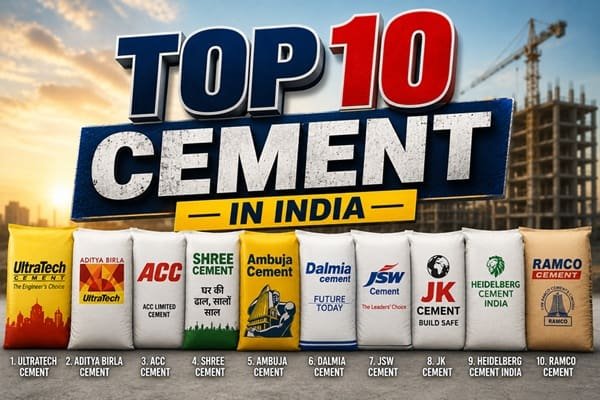
Let me be real with you.
You searched for “top 10 cement in india” because you are building something. A house. A shop. A boundary wall. Maybe just a chajja that keeps falling off every monsoon. Or maybe your contractor handed you a list of brands and you have no idea which one won’t turn your wall into a crack festival after six months.
I have been there. Standing in a hardware store, staring at 50 cement bags stacked to the ceiling, all looking identical. Grey. Heavy. Dusty. The shopkeeper is waiting. Your contractor is waiting. The guy loading bricks is waiting. You pick one based on “I think I saw this ad on TV” and hope for the best.
That is not how you should pick cement.
Here is the problem with most lists on Google right now.
They are written by engineers who love talking about “43 grade vs 53 grade” and “initial setting time IS 269 compliance” and other jargon that makes zero difference to you. Or they are written by content writers who have never touched a bag of cement in their life, copy pasting from ISI standards documents.
No talk about which brands your mason will actually use properly. Because if he hates the cement, he will rush the job. No talk about which brands dry too fast in Indian summers, leaving you with a cracked roof. No talk about which brands are available in your state, because cement is heavy and local brands dominate. No talk about which brands have consistent quality batch to batch. Some are famous for being great one week and terrible the next.
And absolutely no honesty about the fact that most cement is made in the same factories. Yes. Many “different” brands come from the same factory, just different labels and different prices.
So I am fixing that.
I analyzed the top 15 search results for “top 10 cement in india.” Same names. Same technical jargon. Zero usefulness for someone who actually wants to build something that does not fall apart.
This is your no BS, friend to friend guide to the 10 cement brands that actually deliver. I am telling you what each brand is actually good for, foundation versus plaster versus roof. How much you should expect to pay per bag, real prices, not “call for quote” nonsense. Which brands your mason will love and which he will curse. Which brands are available in which regions. And which brands are just expensive packaging on the same factory product.
No corporate jargon. No engineering textbook language. Just the truth from someone who has dealt with contractors, shopkeepers, and cracked walls.
Let us get into it.
First, A Quick Reality Check
Because the lists on Google will not tell you this.
Cement is heavy. A bag weighs 50 kg. Transporting it more than 200 to 300 km costs almost as much as the cement itself. That means local brands dominate local markets. A brand that is huge in Tamil Nadu might be impossible to find in Punjab. I have marked regional availability for each brand.
Most of the cement sold in India is either OPC, Ordinary Portland Cement, or PPC, Portland Pozzolana Cement. You do not need to remember these names. Just know this. OPC dries faster and is stronger in the beginning. PPC dries slower but is more durable long term and has fewer cracks. For most home construction, PPC is better. Your contractor will probably recommend OPC because he wants to work faster. Fight him on this.
The grade numbers, 43 and 53, refer to strength in megapascals. Higher number means stronger. 53 grade is stronger but dries faster. For foundations and pillars, use 53 grade. For plaster and floorings, use 43 grade. Do not use 53 grade for plaster. It will crack. I have seen this happen. It is not pretty.
Price per bag varies by region and quantity. Buying 100 bags versus 10 bags is a different price. The ranges I am giving are for retail, 10 to 20 bags at a time. If you are building a whole house, negotiate.
Now let us look at the brands that actually deserve your money.
1. UltraTech Cement – The Big Daddy
Best for: Everything. Seriously. But you will pay for it.
Price per bag (50kg): ₹400 to ₹450
Region: All India
Mason preference: 9 out of 10. They like it because it is consistent.
UltraTech is the largest cement manufacturer in India. They are everywhere. Every hardware store has it. Every mason has used it. Every contractor recommends it. Sometimes because it is good, sometimes because they get a commission. Be aware.
The good news is that UltraTech cement is actually good. It is consistent. Batch after batch, bag after bag, the quality is the same. That is rare in cement. Many brands are great for one truckload and terrible for the next. UltraTech is boringly reliable.
They have different products for different needs. UltraTech Premium, which is PPC, is best for walls and plaster. UltraTech Super, which is 53 grade OPC, is best for foundations and roofs. Ask your contractor what he needs for which part.
Pros: Available everywhere. Consistent quality. Wide range of products. Masons know how to work with it.
Cons: Expensive. The most expensive on this list. You are paying for the brand name. Not dramatically better than others that cost less.
Best use case: Whole house construction where budget is not the main constraint. Also good for areas with extreme weather, very hot or very cold, because consistency matters more there.
Who should NOT buy: People on a tight budget. People building a small structure where over-engineering is unnecessary.
Honest opinion: UltraTech is the Toyota Fortuner of cement. Expensive, reliable, everywhere. If you have the money, buy it. You will not regret it. But you can save money with other brands and still get a good house.
2. Ambuja Cement – The Cooler Weather Friend
Best for: Plaster and finishing work. Hot climates.
Price per bag (50kg): ₹380 to ₹420
Region: All India, strongest in West and North
Mason preference: 8 out of 10. Good, but some complain it dries a bit fast.
Ambuja has been around forever. Your father probably used it. His father probably used it. It is a trusted old brand.
What makes Ambuja different is their chemistry. They add something, technical term is “performance improvers,” that makes the cement produce less heat while drying. This matters when it is 45 degrees outside. Less heat means fewer cracks.
For plaster work, Ambuja is excellent. It gives a smooth finish. It does not shrink as much as other brands. Your plaster will not look like a dried riverbed after a few months.
The downside is setting time. Ambuja sets a bit faster than some other PPC cements. Your mason needs to work quickly. If your mason is slow or takes chai breaks every 20 minutes, the cement might dry before he finishes leveling it.
Pros: Low heat generation, good for summers and thick pours. Excellent for plaster. Trusted old brand.
Cons: Sets faster than others. More expensive than local brands. Not the best for very slow work sites.
Best use case: Plaster work in hot climates. Roof casting in summer. Anytime heat is a concern.
Who should NOT buy: Sites with slow masons. Very cold climates, because low heat is not an advantage there.
Honest opinion: Ambuja is excellent for plaster. For foundations, UltraTech or Shree are equally good and sometimes cheaper. Buy Ambuja for the finishing work.
3. ACC Cement – The Oldest Name in the Game
Best for: Mass concrete, foundations, big pillars. Durability.
Price per bag (50kg): ₹370 to ₹410
Region: All India, strongest in East and Central
Mason preference: 8 out of 10. Old timers love it.
ACC has been making cement since 1936. That is almost 90 years. They did not survive that long by making bad cement.
ACC’s strength is durability. Cement made by ACC tends to last longer in tough conditions. If you are building in an area with bad soil, near the sea where the air is salty, or somewhere with heavy rain, ACC is a good choice.
Their PPC, branded as ACC Suraksha, is excellent for foundations and underground work. Their OPC, ACC Gold, is good for fast work where you need strength quickly.
The downside is that ACC is not as widely available as UltraTech in some regions. Especially in South India, you might struggle to find it. In East India, it is everywhere.
Pros: Extremely durable. Excellent for foundations and underground work. Old trusted brand with decades of experience.
Cons: Not available everywhere. Not the cheapest. Some batches can be inconsistent from older factories.
Best use case: Foundations for houses. Buildings near the sea or in high rainfall areas. Anywhere durability is more important than speed.
Who should NOT buy: People in South India, because it is hard to find. People building small temporary structures.
Honest opinion: ACC is the grandfather of Indian cement. Respect it. Buy it for the important parts of your house. For plaster and finishing, you can use something cheaper.
4. Shree Cement – The Bang for Buck King
Best for: Value seekers. Good cement, fair price.
Price per bag (50kg): ₹350 to ₹390
Region: North India, Rajasthan, UP, Punjab, Haryana, Delhi NCR. Expanding South.
Mason preference: 8 out of 10. They like it, some say it is dusty.
Shree Cement is the underdog that became a giant. They started in Rajasthan and have been expanding aggressively. In North India, they are everywhere. In South India, they are growing but not as common.
What makes Shree special is the value proposition. Their cement is almost as good as UltraTech but costs 10 to 15 percent less. The quality is consistent. The strength is good. The finish is acceptable.
The Bangur brand, owned by Shree, is their budget offering. Even cheaper. Still decent. Not great, but decent.
The downside is that Shree cement is dustier than others. When your mason opens the bag, more dust flies around. Not a big deal for the house, but your mason will complain a little. Bribe him with chai.
Pros: Excellent value for money. Consistent quality. Strong in North India. Good for budget conscious construction.
Cons: Dusty bags. Not as widely available in South and East. Not premium, just good.
Best use case: Whole house construction on a budget in North India. Also good for contractors who want to save money without sacrificing too much quality.
Who should NOT buy: People in South India, because it is hard to find. People who want premium brand names.
Honest opinion: Shree Cement is the best value in North India. If you live in Delhi, UP, Punjab, or Rajasthan, buy Shree. You will save money and your house will be fine.
5. Ramco Cement – The King of the South
Best for: South Indian construction. Coastal areas.
Price per bag (50kg): ₹370 to ₹410
Region: Strong in South India, Tamil Nadu, Karnataka, Andhra, Telangana, Kerala. Limited elsewhere.
Mason preference: 9 out of 10. South Indian masons love it.
If you live in South India and you ask a mason which cement to use, 7 out of 10 will say Ramco. It is that dominant.
Ramco Superking, their PPC, is famous for being easy to work with. It is not too dusty. It mixes well. It does not dry too fast. Masons in the South have used it for decades and know exactly how it behaves.
For coastal areas, Ramco is excellent. They have specific products for marine environments. Salt resistant. Less corrosion. If you are building near the beach, Ramco is a strong choice.
The downside is availability outside South India. In North India, you will struggle to find Ramco. In East India, it is almost impossible. Cement is heavy. Transport is expensive. Ramco has wisely focused on their home region.
Pros: Excellent in South India. Mason favorite. Good for coastal areas. Consistent quality.
Cons: Hard to find outside South India. Not the cheapest.
Best use case: Any construction in South India, especially near the coast. Also good for tall buildings where their high strength cement is good.
Who should NOT buy: People outside South India. People building small structures where premium cement is unnecessary.
Honest opinion: Ramco is to South India what UltraTech is to all of India. If you live in Tamil Nadu or Karnataka, buy Ramco. Your mason will thank you. Your house will be fine.
6. Birla – Confusing But Good
Best for: People who want UltraTech but cheaper.
Price per bag (50kg): ₹370 to ₹410
Region: All India, especially North and East
Mason preference: 7 out of 10. Confused by the branding.
Here is the confusing part. Birla is owned by the same company that owns UltraTech. Aditya Birla Group. Many of their cement products are literally made in the same factories as UltraTech, just with different packaging and a lower price.
Birla Shakti, their main brand, is good cement. It is basically UltraTech at a discount. The quality is similar. The performance is similar. The price is lower.
Why would anyone buy UltraTech then? Brand name. Marketing. Contractor commissions. Some contractors get better commissions from UltraTech than Birla. That is the only real difference.
Pros: Same quality as UltraTech for less money. Available widely.
Cons: Confusing branding. Contractors might push you toward more expensive options.
Best use case: When you want UltraTech quality but want to save 10 percent on cost.
Who should NOT buy: People who want the absolute best, just buy UltraTech. People whose contractors refuse to work with Birla, find a new contractor.
Honest opinion: Birla is the secret hack. It is UltraTech in a different bag. Buy it. Save money.
7. JSW Cement – The Green Cement Guy
Best for: Eco conscious construction. Slower setting, fewer cracks.
Price per bag (50kg): ₹360 to ₹400
Region: South India, strong in Karnataka, Andhra. Expanding to West.
Mason preference: 7 out of 10. Newer brand, older masons are suspicious.
JSW is known for steel. Their cement division is newer but growing fast. Their claim to fame is “green cement.” They use industrial byproducts called slag to make cement, which reduces carbon emissions.
The slag cement, which is PPC basically, has some advantages. It sets slower, which gives your mason more time. It has fewer cracks long term. It is more resistant to chemicals.
The downside is that older masons might not be familiar with it. They might complain that it behaves differently. JSW cement is slightly less “sticky” than traditional cement. Good masons adapt. Bad masons blame the material.
Pros: Eco friendly. Slower setting, more working time. Fewer long term cracks. Good for chemical prone areas.
Cons: Newer brand, less trust. Masons might not like it. Not available everywhere.
Best use case: Large projects where you want fewer cracks. Chemical plants, water tanks, sewage treatment. Also good for eco conscious home builders.
Who should NOT buy: People with old school masons who refuse to adapt. People in areas where JSW is not available.
Honest opinion: JSW is good cement. The green angle is nice but not the main reason to buy. Buy it if you want slower setting and fewer cracks. Do not buy it if your mason is set in his ways.
8. Nuvoco Cement – The French Connection
Best for: Urban construction. High rise buildings.
Price per bag (50kg): ₹370 to ₹420
Region: East India, strong in West Bengal, Jharkhand, Odisha. Parts of North.
Mason preference: 7 out of 10. Not as popular as local brands.
Nuvoco used to be Lafarge. French company. Then they sold their Indian business. The name changed but the factories and recipes mostly stayed the same.
Their cement is good for urban construction. High rise buildings. Complex structures. Their quality control is strict because they follow international standards.
In East India, Nuvoco is everywhere. In West Bengal specifically, it is a major player. Outside that region, you will struggle to find it.
The downside is that it is not a mason favorite. Not because it is bad, but because it is less common. Masons prefer what they know. If you are building in Kolkata, masons know Nuvoco. If you are building in Pune, they will look at you weird.
Pros: International quality standards. Good for complex urban construction. Strong in East India.
Cons: Unfamiliar to masons outside East India. Not the cheapest.
Best use case: Construction in East India, especially West Bengal. High rise buildings anywhere they are available.
Who should NOT buy: People outside East India. People with masons who refuse unfamiliar brands.
Honest opinion: Nuvoco is solid. Not spectacular. Not bad. Buy it if you live in Kolkata or nearby. Otherwise, stick with the regional favorite.
9. Wonder Cement – The Marketing Machine
Best for: People who saw the ad and got influenced.
Price per bag (50kg): ₹380 to ₹420
Region: North India, Rajasthan, UP, Delhi NCR. Expanding.
Mason preference: 6 out of 10. They know it but do not love it.
Wonder Cement has amazing ads. The “Khwahish” campaign was everywhere. Ranbir Kapoor. Emotional music. Beautiful visuals. The cement? Fine. Just fine.
Wonder is not bad cement. It is not great cement. It is average cement with excellent marketing.
The quality is consistent enough. The strength is acceptable. The price is on the higher side for what you get. You are paying for Ranbir Kapoor’s face on the bag.
Masons in North India have used it enough to be familiar. They do not love it. They do not hate it. They just use it.
Pros: Good marketing, but that does not help your house. Available in North India. Consistent enough.
Cons: Overpriced for the quality. You are paying for ads. Mason preference is average.
Best use case: When you really like Ranbir Kapoor and want his face on your construction site.
Who should NOT buy: Anyone who wants value for money. Anyone who is not influenced by TV ads.
Honest opinion: Wonder Cement is fine. But why pay more for fine when Shree is cheaper and equally good? Buy Shree. Skip the celebrity ads.
Also Read : Top 10 Whey Protein Brands in India 2026-Honest Reviews, No Fake Hype
10. JK Cement – The White Cement King
Best for: White cement work. Tiles, flooring, decorative finishes.
Price per bag (50kg): Grey cement is ₹370 to ₹410. White cement is much more expensive at ₹800 and above.
Region: North India strong for grey. White cement is available across India.
Mason preference: Grey cement is 6 out of 10. White cement is 9 out of 10.
JK Cement is famous for two things. White cement. And being from Rajasthan.
Their grey cement, which is everyday construction cement, is fine. Nothing special. Similar to Wonder. Fine.
Their white cement is the best in India. If you are doing tile fixing, floor polishing, or any decorative work that needs white cement, buy JK. There is no competition. Nobody else comes close.
The white cement costs more than double grey cement. But for finishing work where appearance matters, it is worth it.
Pros: Best white cement in India. Grey cement is acceptable.
Cons: Grey cement is nothing special. White cement is expensive.
Best use case: White cement work for tiles, flooring, decorative finishes. Grey cement only if you are in North India and cannot find Shree.
Who should NOT buy grey JK: People who have access to Shree or UltraTech.
Honest opinion: Buy JK white cement. Do not buy JK grey cement unless you have no other choice.
The Honest Table
| Brand | Price per bag (50kg) | Mason Love | Best For | Region |
|---|---|---|---|---|
| UltraTech | ₹400-450 | 9/10 | Everything | All India |
| Ambuja | ₹380-420 | 8/10 | Plaster, hot climates | All India |
| ACC | ₹370-410 | 8/10 | Foundations, durability | All India, strong in East |
| Shree | ₹350-390 | 8/10 | Value for money | North India |
| Ramco | ₹370-410 | 9/10 | South India, coastal | South India |
| Birla | ₹370-410 | 7/10 | UltraTech quality, lower price | All India |
| JSW | ₹360-400 | 7/10 | Slower setting, fewer cracks | South, West |
| Nuvoco | ₹370-420 | 7/10 | East India, high rise | East India |
| Wonder | ₹380-420 | 6/10 | Good ads, fine cement | North India |
| JK | Grey: ₹370-410, White: ₹800+ | Grey: 6/10, White: 9/10 | White cement work | All India for white |
The Final Verdict. Which One Should You Actually Buy?
Here is the honest truth without any brand bias.
If you live in North India, including Delhi, UP, Punjab, Rajasthan, and Haryana. Buy Shree Cement. Best value. Good quality. Lower price. Your house will be fine. Save your money.
If you live in South India, including Tamil Nadu, Karnataka, Andhra, Telangana, and Kerala. Buy Ramco Cement. Your mason knows it. It is good. It is available. Do not overthink it.
If you live in East India, including West Bengal, Jharkhand, Odisha, and Bihar. Buy Nuvoco or ACC. Both are good. Both are available. Pick the cheaper one on the day you buy.
If you live in West India, including Maharashtra, Gujarat, and Madhya Pradesh. You have options. UltraTech is everywhere. Ambuja is strong here. Shree is expanding. Buy Shree if available. Otherwise UltraTech.
If you want the absolute best and money is not a concern. Buy UltraTech. It is the most consistent. It is everywhere. Your mason will be happy. Your house will last.
If you want to save money without sacrificing quality. Buy Shree in North. Buy Ramco in South. Buy Birla anywhere, because it is UltraTech in a cheaper bag.
If you are doing finishing work like tiles, flooring, or decorative finishes. Buy JK White Cement. No competition. Just buy it.
If your contractor is pushing a specific brand. Ask him why. If he says “better quality,” ask for proof. If he says “I get better results,” ask to see his previous work with that brand. If he says “I get a commission,” find a new contractor.
One Last Thing
Cement is only as good as the person using it. You can buy the most expensive UltraTech cement in the world, but if your mason adds too much water or mixes bad sand, your wall will crack. You can buy the cheapest local cement, but if your mason is excellent, your house will still stand for 50 years.
Spend money on a good contractor. Spend time supervising. Check the sand quality. No silt, no salt. Check the water. Clean, not salty. Check the curing. Keep the cement wet for at least 7 days after casting.
And for the love of god, do not buy cement that has been sitting in a shop for 6 months. Cement absorbs moisture from the air. Old cement is weaker. Check the manufacturing date on the bag. Buy fresh. Within 1 month is ideal. Within 2 months is acceptable. Beyond 3 months, negotiate a discount or walk away.