
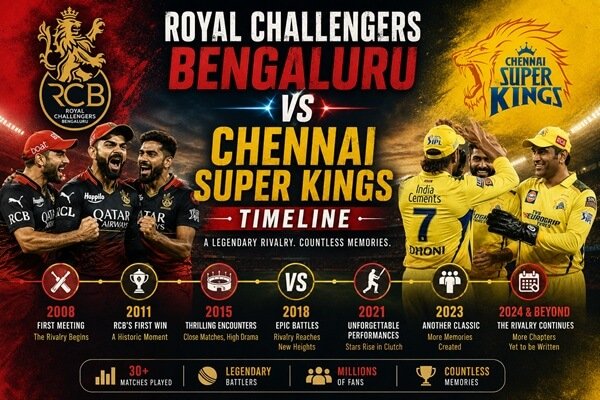
Ask any IPL fan to name the league’s defining rivalry, and most will not say Mumbai vs Chennai. They will say RCB vs CSK, a matchup that has almost nothing to do with even competition and everything to do with two of the tournament’s most recognizable icons, Virat Kohli and MS Dhoni, standing on opposite sides of the pitch year after year.
For most of its history, this fixture has not been close. Chennai Super Kings have owned it, building a lead that stretched past twenty wins while Royal Challengers Bengaluru searched for the consistency to match their talent. And yet no rivalry in the IPL generates the same noise, the same pre-match build-up, or the same sense that anything could happen once the two sides actually take the field. That contradiction, lopsided history against unpredictable theatre, is what makes this fixture worth understanding properly.
| 36Total meetings | 21-14CSK leads (1 no result) | 2011Only IPL final meeting |
The Early Years: Chennai Builds a System, Bengaluru Searches for One
From the league’s first season in 2008, the gap between these two franchises was less about talent and more about identity. Chennai Super Kings, under MS Dhoni from day one, built a team defined by calm, clearly defined roles, and composure in tight finishes. Royal Challengers Bengaluru had arguably the more star-studded batting lineups of the era, but struggled to translate individual brilliance into consistent results as a team.
That contrast showed up immediately in head-to-head results. CSK’s biggest win in the fixture’s history, a 92-run victory, actually came away from India entirely, in Johannesburg during the 2009 season, when the IPL was relocated to South Africa because of general elections in India. It was an early sign of how thoroughly Chennai had figured out its identity, even outside home conditions, while RCB was still searching for its own.
2011: The Only Final These Two Have Ever Played
The rivalry’s single biggest match remains the 2011 IPL final at the MA Chidambaram Stadium in Chennai. Batting first, CSK posted 205/5, built around Murali Vijay’s 95 off 52 balls at the top of the order. RCB’s chase never got going. Chris Gayle, their most destructive batter that season, was dismissed for 0, and despite a fighting 35 from Kohli, RCB were bowled out for 147. CSK won by 58 runs, becoming the first franchise in IPL history to successfully defend a title. For RCB, it remains the closest they have come to lifting the trophy in a meeting against Chennai, and the defeat became a defining, painful chapter in the club’s long wait for silverware.
The Chepauk Fortress and the Weight of Home Advantage
Much of Chennai’s dominance in this fixture is tied directly to their home ground. At the MA Chidambaram Stadium, known to fans as Chepauk, CSK has historically won roughly eight of every ten meetings against RCB, an extraordinary home record even by IPL standards. The pitch’s tendency to assist spin bowling as matches wear on has repeatedly played to Chennai’s strengths, epitomized by a 2019 meeting where RCB collapsed to just 70 all out at Chepauk, the lowest total either side has posted in the fixture’s history.
That home dominance is a large part of why the head-to-head record leaned so heavily toward Chennai for over a decade. It was not simply about squad quality. It was about one team consistently controlling the conditions that mattered most whenever the two sides met on Chennai soil.
Dhoni’s Signature Theatre Against Bengaluru
If there is one player whose individual performances define this fixture’s dramatic reputation, it is MS Dhoni. In 2018 at the M. Chinnaswamy Stadium in Bengaluru, chasing 206 with CSK stumbling to 74/4 after nine overs, Dhoni produced an unbeaten 70 off just 34 balls, including seven sixes, to drag his side to an unlikely win. A year later, at the same ground, chasing 162, Dhoni again exploded late, smashing 84 not out off 48 balls and 24 runs off the final over alone, only to fall one run short as CSK lost by the narrowest possible margin. Both innings, one a triumph and one a heartbreak, are still replayed by fans as evidence of exactly why this fixture rarely produces a dull finish, regardless of the eventual head-to-head tally.
The Balance Begins to Shift: 2019 to 2025
Chennai’s most dominant stretch in the fixture actually came between 2015 and 2021, when they won ten of thirteen meetings, reinforcing the perception of total control. But beneath that stretch, the tide was already starting to turn. Since 2019, RCB has won four of the seven completed meetings between the sides, a much tighter distribution than the fixture’s overall history suggests.
That shift became impossible to ignore in 2025. Royal Challengers Bengaluru swept both meetings against Chennai that season for the first time in the rivalry’s history, including a 50-run win at Chepauk that broke a seventeen-year losing streak at the ground long considered Chennai’s fortress. The same year, RCB finally won its first-ever IPL title, beating Punjab Kings in the final. For a fixture long defined by one team’s frustration against the other’s control, 2025 flipped the emotional weight of the rivalry almost overnight.
The Middle Years: A Fixture Full of Streaks
Between the 2011 final and the recent shift toward RCB, this rivalry rarely moved in small increments. It moved in streaks. The 2015 season stands out as one of Chennai’s most complete stretches in the matchup, sweeping all three meetings that year, including a playoff clash, a reminder that Chennai’s control over this fixture was never limited to bilateral league games alone. That kind of season-long sweep became something of a pattern for Chennai across the mid-2010s, reinforcing a psychological edge that seemed to compound over time. RCB, for its part, would occasionally break through with a statement win, but rarely managed to string together the same kind of consistent run against Chennai that would have signaled a genuine shift in control.
What makes this stretch worth understanding is how much it shaped the narrative long before the numbers started narrowing. By the time CSK reached its 2015-2021 peak of ten wins in thirteen meetings, the head-to-head record had built up such a wide gap that even RCB’s better individual performances during this period were framed by commentators and fans as exceptions to the rule rather than signs of a genuine turnaround. That framing would only change once RCB’s results against Chennai became too consistent to dismiss as isolated upsets.
2026: The Rivalry Refuses to Cool Down
Heading into the 2026 season, RCB arrived as defending champions, and the form continued. In their season opener, RCB chased down 202 against Sunrisers Hyderabad in just 15.4 overs, the fastest 200-plus run chase in IPL history, with Kohli making an unbeaten 69 and Devdutt Padikkal blitzing 61 off 26 balls. When RCB and CSK met again in April 2026, in what was billed as one of the season’s must-watch fixtures, RCB extended their recent dominance further with a comfortable win, stretching their run against Chennai to four consecutive victories and narrowing the all-time head-to-head gap to 21-14 with one no result across 36 meetings.
Also read: India National Cricket Team vs England Cricket Team Timeline
Player Spotlight: The Names That Define This Fixture
Virat Kohli is, unsurprisingly, the leading run-scorer in the history of this matchup, having passed 1,100 runs against Chennai across his RCB career, a tally built through a mix of gritty rebuilding innings and the occasional explosive counter-attack. MS Dhoni sits behind him with well over 800 runs, most of them delivered in exactly the kind of late-innings chaos that turned the 2018 and 2019 Bengaluru meetings into instant classics. Suresh Raina also ranks among the fixture’s most productive batters, a reflection of how central Chennai’s middle order has been to the team’s long-term control of this matchup.
With the ball, Ravindra Jadeja leads all bowlers in the rivalry with 18 wickets, with West Indian all-rounder Dwayne Bravo close behind on 17, both central figures in Chennai’s bowling identity through the 2010s. On the RCB side, no single bowler has dominated the matchup the way Jadeja and Bravo have for Chennai, which is itself a small but telling detail about why this fixture tilted so heavily toward Chennai for so long: control with the ball late in an innings has, for most of this rivalry’s history, belonged to the Yellow Army.
The Numbers That Matter Most
| Category | Chennai Super Kings | Royal Challengers Bengaluru |
| All-time wins in this fixture | 21 | 14 |
| Highest team total | 226 | 218 |
| Lowest team total | 82 (2008) | 70 (2019, Chepauk) |
| Leading run-scorer for the team | MS Dhoni, 800+ | Virat Kohli, 1,100+ |
| Leading wicket-taker for the team | Ravindra Jadeja, 18 | No individual bowler with comparable tally |
| Record in the only final meeting (2011) | Won by 58 runs | Runners-up |
Why This Fixture Still Feels Bigger Than the Scoreline
On paper, a rivalry where one team has won roughly 60 percent of all meetings should not carry the emotional weight this one does. But IPL fixtures are rarely just about the aggregate numbers. This one is carried by two of the most recognizable captains and batters the tournament has ever produced, by a shared history of RCB chasing a first title while Chennai kept collecting them, and by a recent run of results that has genuinely reopened the question of who controls this matchup going forward. Add in Chepauk’s late-innings drama, Dhoni’s finishing instincts, and Kohli’s long personal history against Chennai bowling, and you have a fixture that has outgrown its own head-to-head record.
There is also a generational angle worth noting. Much of this rivalry’s early identity was built around players who have since retired or moved into the final stretch of their careers, which means the next several seasons will likely be shaped by a newer core on both sides. How that transition plays out, whether RCB’s recent momentum belongs to a genuine changing of the guard or a temporary window, is arguably the single most interesting open question hanging over this fixture heading into the rest of the decade.
Quick Answers
Who leads the RCB vs CSK head-to-head record? Chennai Super Kings, with 21 wins to RCB’s 14 from 36 meetings, and one match ending in no result.
Have RCB and CSK ever met in an IPL final? Yes, only once, in 2011, when CSK won by 58 runs to become the first franchise to defend an IPL title.
Why is Chepauk considered a fortress for CSK against RCB? CSK has historically won around eight of every ten meetings against RCB at the venue, helped by used pitches that increasingly favor spin as matches progress.
What was RCB’s lowest score against CSK? RCB were bowled out for 70 at Chepauk in 2019, the lowest total either side has posted in the fixture’s history.
Who are the leading run-scorer and wicket-taker in this rivalry? Virat Kohli leads all batters with more than 1,100 runs, while Ravindra Jadeja leads all bowlers with 18 wickets.
Has the balance of the rivalry changed recently? Yes. RCB has won four of the last five meetings, including a season sweep in 2025 that included a first-ever win at Chepauk in seventeen years.
Did either team’s recent form affect a major title race? RCB won their maiden IPL title in 2025, the same season they swept both meetings against Chennai, adding new context to a rivalry long defined by RCB chasing its first championship.
What is considered the most dramatic individual performance in this fixture? MS Dhoni’s back-to-back finishing efforts in Bengaluru in 2018 and 2019, an unbeaten 70 that won a game and an unbeaten 84 that agonizingly fell one run short the following year.
| The Bottom Line Chennai Super Kings still lead the all-time record against Royal Challengers Bengaluru, and that history, built on Chepauk’s home advantage and a decade of composed cricket under MS Dhoni, is not going to disappear from the record books. But the last two seasons have genuinely changed how this fixture feels. RCB is no longer the team chasing its first title while Chennai collects trophies; both sides are now champions, and the head-to-head gap is shrinking in real time. Few rivalries in the IPL combine that much history with that much present-day uncertainty, which is exactly why RCB vs CSK remains appointment viewing every single season. |