
There is one thing that stands out immediately when you look at BackToFrontShow: the price is much higher than most podcast tools people normally come across.
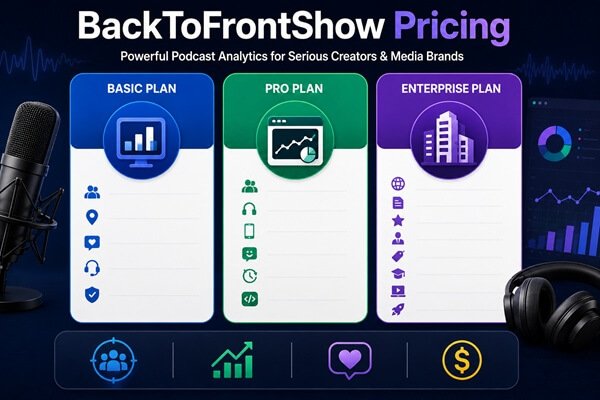
The current official website lists the Basic plan at $1,200 per month, the Pro plan at $3,600 per month, and an Enterprise option with pricing available directly from the company.
That means this isn’t really a “Which cheap podcast tool should I try?” decision.
It’s a business decision.
At $1,200 a month, the Basic plan represents $14,400 over 12 months if you simply multiply the monthly price by a year. Pro works out to $43,200 a year at its published monthly rate.
So the important question isn’t just “What is BackToFrontShow pricing?”
It’s:
What are you getting for that money, and does your podcast actually need it?
That’s where things get interesting.
The short version
If you only came here for the numbers, here’s the current pricing shown on the official BackToFrontShow website:
| Plan | Published price | Position |
|---|---|---|
| Basic | $1,200/month | Core analytics |
| Pro | $3,600/month | Deeper audience and behavior data |
| Enterprise | Custom | Advanced business requirements |
The official site also shows that the three plans are built around different levels of podcast analytics, audience information, reporting and support.
There is no publicly displayed Enterprise price.
And there is an important reason not to blindly copy prices from random BackToFrontShow pricing articles.
Some websites currently give completely different numbers or descriptions of the product. The official pricing page is therefore the best place to verify the actual subscription figures.
The first thing to understand about BackToFrontShow
BackToFrontShow is presented as a podcast analytics and audience-insights platform.
The idea is that basic podcast statistics aren’t always enough.
Knowing that an episode received 50,000 downloads is useful.
Knowing who listened, where they listened, how they interacted, how episodes performed and how listening patterns changed can be much more useful for a professional media business.
The BackToFrontShow website currently highlights features such as listener demographics, episode performance, listening trends, feedback analysis and reporting.
That’s a different proposition from a simple podcast hosting dashboard.
You aren’t paying $1,200 just to see whether an episode received 10,000 or 20,000 plays.
You’re paying for deeper information that is supposed to help you understand the audience behind those numbers.
So, why is the starting price $1,200?
This is where many people will probably stop and ask whether the price is a mistake.
It isn’t.
The official pricing page currently shows:
Basic — $1,200/month
Pro — $3,600/month
Enterprise — Contact Us for Pricing
The pricing puts BackToFrontShow in a very different category from inexpensive podcast software.
It appears to be aimed at organizations where audience data has a direct commercial value.
Think about a podcast network with multiple advertisers.
If better audience information helps the company sell sponsorships, improve content decisions or understand listener behavior, the analytics can potentially have a business value far above the software bill.
For someone running a podcast as a hobby, the same $1,200 may be extremely difficult to justify.
That’s the key distinction.
What does $1,200 actually buy?
The Basic plan is not an empty entry-level package.
According to the official pricing page, it includes comprehensive analytics covering listener demographics and playback locations. It also includes engagement monitoring, customer support and data-security features.
In practical terms, you are getting information that can help answer questions such as:
- Where are listeners located?
- What age groups are represented?
- Where are episodes being played?
- How are people interacting with the content?
- What does audience engagement look like?
That information can be useful when you’re trying to understand whether your audience matches the audience you think you have.
And that matters for advertising.
A simple example
Imagine you run a business podcast.
You assume your audience is mostly in the United States because most of your social-media followers are American.
But the analytics show something different.
Perhaps a large percentage of listeners are actually coming from Canada, the United Kingdom and Australia.
That could change the way you approach sponsors.
It could also influence future guests, episode topics and advertising campaigns.
That’s the kind of decision deeper analytics are meant to support.
The Basic plan isn’t necessarily “basic”
The word Basic can be misleading.
At $1,200 per month, this isn’t a beginner subscription in the usual sense.
It is the entry-level tier of an expensive analytics product.
The official page lists:
- Listener demographic analysis
- Playback-location analysis
- User engagement monitoring
- Likes, shares and comments
- 24/7 customer support
- Data-security features
So “Basic” really means the first level of BackToFrontShow’s analytics system, not “a cheap plan for beginners.”
That’s an important distinction if you’re comparing it with other podcast software.
Then comes the big jump: Pro
Going from Basic to Pro isn’t a small upgrade.
You’re moving from $1,200 to $3,600 per month.
That’s an additional $2,400 every month.
Over 12 months, the difference is $28,800.
So the Pro plan needs to offer something that actually matters to your operation.
It does.
The official pricing page adds several deeper analytics capabilities to Pro, including listening-behavior tracking, device analytics, AI-driven sentiment analysis, feedback aggregation, real-time data updates and API integration.
The question is whether you will use them.
Where Pro starts making more sense
Let’s say your podcast has grown into a proper media business.
You have:
- A marketing team
- Multiple people working on content
- Sponsorship deals
- A large audience
- Several distribution channels
- Regular reporting requirements
At that point, knowing the total number of downloads isn’t enough.
Your team may want to know:
Which episodes keep people listening?
Which topics create the strongest response?
Which devices are people using?
Where are listeners coming from?
What are people saying about episodes?
Is audience behavior changing?
This is where the additional Pro features become more relevant.
Listening behavior is one of the more useful upgrades
The Pro plan includes listening behavior tracking.
The official site describes this as monitoring episode popularity and average listening time.
That’s valuable because a download number doesn’t tell you whether somebody actually consumed the episode.
Consider two episodes.
Episode A:
100,000 downloads
Average listening time: 8 minutes
Episode B:
70,000 downloads
Average listening time: 42 minutes
If you’re only looking at downloads, Episode A wins.
If you’re trying to understand audience attention, Episode B may be much more interesting.
That difference can influence how you produce future episodes.
Device analytics can answer another useful question
The Pro plan also includes multi-platform device analytics.
This can help a media team understand the devices and platforms its audience prefers.
Why does that matter?
Because listener behavior can differ depending on where and how people consume content.
A listener using a phone during a commute may behave differently from someone listening at home through another device.
Understanding those patterns can help with content planning and audience strategy.
What about the AI sentiment feature?
Another Pro feature is AI-driven sentiment analysis.
The official pricing page says the system can categorize feedback as positive, negative or neutral.
This sounds particularly useful for podcasts that receive a lot of comments and audience feedback.
Imagine an episode generates 5,000 comments.
Reading every comment manually would take a huge amount of time.
A sentiment system can help organize the feedback into broader groups.
But don’t treat sentiment analysis as perfect.
People use sarcasm.
People joke.
People write short comments without enough context.
An automated system can misunderstand those things.
So this feature is best viewed as a way to spot patterns, not as a replacement for human judgment.
Also read: CNLawBlog Explained: What It Is, What It Covers, and How to Use It
Feedback aggregation solves a practical problem
Podcast feedback is often scattered.
You may have comments on one platform, social-media discussions somewhere else, emails from listeners and other forms of audience response.
BackToFrontShow’s Pro plan includes holistic feedback aggregation.
The benefit is simple:
Instead of looking in several places, your team can have a more centralized view of audience feedback.
For a large show, that can save time.
For a small show with 50 comments a month, it probably isn’t a major reason to spend thousands of dollars.
Real-time data is useful — but only if you need it
Pro also includes real-time data updates.
This can matter during a major launch.
Suppose a well-known guest appears on your podcast.
The episode suddenly starts receiving large amounts of attention.
A media team may want to see what is happening immediately rather than waiting for a later reporting cycle.
Real-time information can help in that situation.
But again, not every podcast needs it.
If you publish once a week and check your analytics once every few days, real-time updates may not justify the Pro upgrade by themselves.
The API could be the feature businesses care about most
Pro also includes API integration.
For a normal creator, this may sound technical and unnecessary.
For a company, it can be very different.
An API can allow data from one platform to interact with another system.
That could matter if your organization has its own:
- Reporting dashboard
- CRM
- Marketing system
- Data warehouse
- Internal analytics tools
The exact API capabilities and usage limits should be confirmed with BackToFrontShow before purchasing.
The pricing page confirms API integration exists, but it doesn’t provide a complete public technical specification.
Enterprise is a different conversation
There is no public Enterprise price.
The official website simply asks interested customers to contact the company.
That isn’t unusual for enterprise software.
Once customers need custom reporting, dedicated support, white-labeling and special onboarding, pricing often depends on the customer.
The Enterprise tier includes a much longer feature list.
Among the published features are:
- Geographical analytics
- Custom reports
- Premium templates
- Priority feature requests
- Dedicated account manager
- White-labeling
- Advanced user training
- Monthly analytics webinars
- Custom onboarding
That tells you who this tier is aimed at.
It isn’t really designed around the needs of an individual podcaster.
What would an Enterprise customer actually use?
Consider a company managing a large podcast network.
It may have several shows, multiple teams and outside clients.
It may need reports that look different from the standard dashboard.
It may want its own branding.
It may need employees trained on the platform.
It may want a dedicated contact instead of sending every question through general support.
Those are the situations where enterprise features become more valuable.
For that type of customer, the question isn’t:
“Can I get cheaper podcast analytics?”
It’s:
“Can this platform fit into our existing operation?”
That’s a completely different buying decision.
BackToFrontShow annual cost: the number people often overlook
The monthly price sounds high.
The yearly number makes it even clearer.
Basic
$1,200 × 12 = $14,400
Pro
$3,600 × 12 = $43,200
Difference
$43,200 − $14,400 = $28,800
These are calculated annual totals based on the published monthly rates. The official pricing page does not currently publish a standard annual discount, so you should ask the company about actual contract pricing before assuming these are the amounts you would pay under an annual agreement.
Is there a free trial?
This is another area where it’s better not to guess.
The BackToFrontShow homepage currently shows a “Start free Trial” option.
The request-access page also asks users to select a pricing plan and says access is subject to approval.
However, the public pricing page does not clearly state the exact trial length or all trial conditions.
So before entering payment details, ask:
- How long does the trial last?
- Is a card required?
- Which features are available?
- Does the trial automatically convert into a paid plan?
- Can access be cancelled during the trial?
That’s especially important when the lowest public plan is $1,200 per month.
Why are there so many different BackToFrontShow prices online?
This is where your article can stand out from the other search results.
There is real confusion in the search results.
Several current articles repeat the official $1,200 and $3,600 figures.
But other pages describe completely different prices and even different products.
For example, one search result claims BackToFrontShow has much cheaper membership-style pricing, while another says the name is being used in multiple contexts.
This means blindly copying the first pricing article you find isn’t a good idea.
The safest approach is to check the actual BackToFrontShow website.
At the time of checking, its official pricing page clearly lists $1,200, $3,600 and custom Enterprise pricing.
A useful way to decide: calculate your “data value”
Here’s a better way to think about the purchase.
Don’t ask:
“Is $1,200 expensive?”
Ask:
“What will this data help me do?”
For example, suppose better analytics help your sales team close one additional $2,000 sponsorship every month.
The Basic subscription could potentially pay for itself.
Now suppose you have a small podcast making $500 a month.
Spending $1,200 every month on analytics would put you underwater before you even consider production costs.
Same software.
Completely different decision.
Who should probably skip BackToFrontShow?
If you’re running a small personal podcast, I’d be cautious.
You probably don’t need this level of analytics if:
- You publish for fun.
- Your show has little revenue.
- You only need basic download information.
- You don’t sell sponsorships.
- You don’t have a marketing team.
- You don’t need API access.
- You rarely analyze audience data.
There is nothing wrong with using a simpler tool.
More data isn’t automatically better.
Unused data is just another expense.
Who could get real value from it?
BackToFrontShow becomes more interesting for:
Podcast networks
They have multiple shows and a lot of audience information to manage.
Media companies
They may need deeper reporting and audience segmentation.
Agencies
They may need reports for clients and possibly white-label options.
Large brands
They may use podcasts as part of a larger marketing strategy.
High-revenue independent shows
If sponsorship revenue is significant, audience analytics can have a direct commercial value.
Three hypothetical buyers
Buyer 1: The hobby creator
Revenue: $200/month
Needs: Basic statistics
BackToFrontShow: Probably unnecessary
The cost doesn’t make sense.
Buyer 2: The established creator
Revenue: $15,000/month
Needs: Audience demographics, engagement and detailed listening behavior
BackToFrontShow: Worth investigating
This person should request a demo and compare the data with the current analytics setup.
Buyer 3: The podcast network
Revenue: $500,000+ annually
Needs: API, reporting, multiple teams, detailed audience data and custom support
BackToFrontShow: Potentially a good enterprise candidate
At this level, the cost should be evaluated against business impact rather than against cheap creator tools.
What should you ask during the demo?
Don’t spend 30 minutes listening to a sales presentation without seeing the product.
Ask them to show you the actual dashboard.
Then ask:
Can you show me listener retention?
Can you show me geographic audience data?
Can I compare multiple episodes?
Can I export reports?
How fresh is the data?
What platforms are supported?
What exactly does the API provide?
Can I connect multiple shows?
How does sentiment analysis work?
What happens to my data if I cancel?
Are there limits on users or data volume?
These questions will tell you much more than a generic feature list.
One thing I would not do
I wouldn’t choose the Pro plan simply because it has more features.
That is a common software-buying mistake.
If Basic gives you everything you actually need, paying an extra $2,400 every month doesn’t make sense.
Upgrade because you need something specific.
For example:
“I need API access.”
“I need real-time reporting.”
“I need listening behavior analysis.”
“I need sentiment analysis.”
Those are real reasons.
“I want the better plan” isn’t.
BackToFrontShow pricing compared with the value of your podcast
The final decision comes down to economics.
For Basic, you’re committing to $1,200 per month.
For Pro, you’re committing to $3,600 per month.
That means the software should be connected to a real business objective.
If you use the analytics to improve:
- Sponsorship sales
- Advertising performance
- Content selection
- Listener retention
- Audience growth
- Marketing decisions
- Client reporting
then the price may be reasonable for the right organization.
If you simply want to know how many people downloaded your latest episode, it probably isn’t.
Final take on BackToFrontShow pricing
BackToFrontShow isn’t priced like a typical entry-level podcast app.
The official website currently places the product at $1,200/month for Basic, $3,600/month for Pro, with Enterprise pricing available by quote.
The Basic tier provides core audience and engagement analytics.
Pro goes deeper into listening behavior, devices, feedback, sentiment, real-time information and API connectivity.
Enterprise adds customization, geographic reporting, dedicated support, white-labeling and other features aimed at larger organizations.
So is BackToFrontShow expensive?
Yes, compared with ordinary podcast analytics tools.
Is that automatically a bad thing?
No.
The real question is whether the information is valuable enough for your business to justify the monthly bill.
For a hobby podcast, I’d look elsewhere.
For a serious podcast business, media agency or network, I’d request access and ask for a proper demonstration before making the decision.
And because the web currently contains conflicting information about what BackToFrontShow is and how much it costs, I would verify the price directly before paying. The official pricing page is currently the clearest source for the $1,200 Basic, $3,600 Pro and custom Enterprise structure.
BackToFrontShow Pricing FAQs
How much is BackToFrontShow?
The official website currently lists Basic at $1,200 per month, Pro at $3,600 per month, and Enterprise as custom pricing.
What is the cheapest BackToFrontShow plan?
The Basic plan is currently the cheapest published option at $1,200 per month.
How much does BackToFrontShow Basic cost annually?
At the published monthly rate, the simple 12-month calculation is $14,400.
How much is BackToFrontShow Pro?
The Pro plan is $3,600 per month.
Does BackToFrontShow have Enterprise pricing?
Yes. Enterprise is available through a custom quote rather than a publicly listed price.
Does BackToFrontShow offer a free trial?
The official homepage currently displays a “Start free Trial” option, while the access page says applications are subject to approval. The public pricing page does not clearly state the exact trial terms.
Is BackToFrontShow worth $1,200 per month?
It depends on your use case. The price is difficult to justify for a hobby creator but may make sense for a professional podcast, media company or network that can use detailed audience data commercially.
What does Pro add over Basic?
Pro adds features such as listening behavior tracking, multi-platform device analytics, AI-driven sentiment analysis, feedback aggregation, real-time updates and API integration.
Does Enterprise have custom reports?
Yes. Custom reports are listed among the Enterprise features.
Can BackToFrontShow provide white-labeling?
White-labeling options are listed under the Enterprise plan.
Where should I verify BackToFrontShow pricing?
The official BackToFrontShow pricing page is the best place to verify the current published subscription prices.