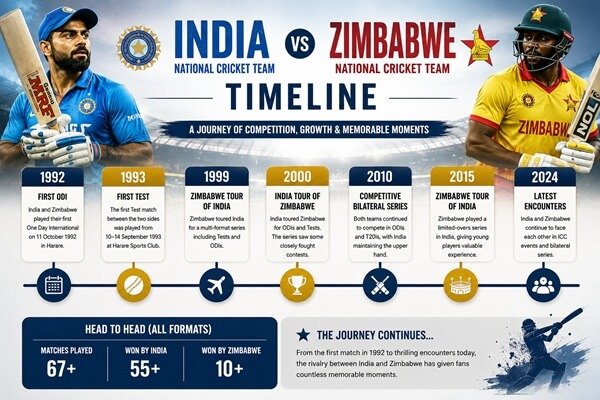
The India vs Zimbabwe cricket timeline tells the story of one of international cricket’s longest-running yet most misunderstood rivalries. On paper, the numbers appear overwhelmingly one-sided. India have dominated the head-to-head record across Tests, One-Day Internationals, and T20 Internationals for more than four decades, winning roughly four out of every five matches played between the two nations.
Yet statistics alone fail to explain why this fixture has remained relevant.
Unlike India’s high-profile rivalries with Pakistan, Australia, or England, matches against Zimbabwe have rarely been defined by championship pressure or political history. Instead, they have served a very different purpose. For India, tours to Zimbabwe have often become an extension of the country’s remarkable talent pipeline, giving emerging players valuable international experience before they graduate to bigger stages. For Zimbabwe, every series against India represents one of the most important events on the cricket calendar, bringing global attention, stronger competition, and an opportunity to challenge one of the world’s strongest cricketing nations.
The rivalry has also produced moments that continue to be remembered decades later. Zimbabwe’s historic Test victory in Harare in 2001, Andy Flower’s extraordinary batting, Heath Streak’s inspirational leadership, and India’s repeated use of Zimbabwe tours to introduce future international stars have all given this fixture an importance that goes far beyond the final score.
As of the latest completed meetings in 2024, India continue to hold a commanding advantage across every format. However, the rivalry’s legacy is better measured by the opportunities it has created, the careers it has launched, and the rare but unforgettable occasions when Zimbabwe reminded the cricket world that even overwhelming favorites can be beaten.
India vs Zimbabwe Head-to-Head Record
Before exploring the complete timeline, here’s a quick overview of the rivalry across all three international formats.
| Format | Played | India Won | Zimbabwe Won | Other Results |
|---|---|---|---|---|
| Test Matches | 11 | 7 | 2 | 2 Draws |
| One-Day Internationals | 66 | 54 | 10 | 2 Tied |
| Twenty20 Internationals | 13 | 10 | 3 | — |
Some historical databases list only nine Test matches rather than eleven, largely because certain older records classify abandoned or incomplete fixtures differently. Regardless of those minor differences, every statistical source tells the same story—India have comfortably led the rivalry across every format since the two nations first met in 1983.
Across nearly 90 international matches, Zimbabwe have managed roughly one victory for every six played. That record reflects India’s superior depth and resources, but it also reflects the different purposes these series have served for both teams.
Key Takeaways
Before diving into the complete India vs Zimbabwe cricket timeline, here are the rivalry’s biggest highlights.
- India and Zimbabwe first met during the 1983 Cricket World Cup.
- Zimbabwe became a Test-playing nation in 1992.
- India have dominated the rivalry across every international format.
- Zimbabwe have recorded two Test victories, including their famous win in Harare in 2001.
- India have frequently used Zimbabwe tours to introduce young international players.
- Andy Flower and Heath Streak remain Zimbabwe’s greatest performers against India.
- No Test series has been played between the two countries since 2005.
- The rivalry continues through ODI and T20I cricket, with Harare hosting most recent matches.
India vs Zimbabwe Cricket Timeline (1983–2024)
Unlike many international rivalries that have followed a consistent pattern, India versus Zimbabwe has evolved through several distinct phases.
The early years were surprisingly competitive.
The late 1990s and early 2000s coincided with Zimbabwe’s strongest generation of cricketers.
The modern era has increasingly become a story of India’s remarkable squad depth and Zimbabwe’s efforts to rebuild international competitiveness.
1983 – The Rivalry Begins
The India vs Zimbabwe cricket timeline officially began during the 1983 Prudential Cricket World Cup.
The two teams met at Leicester, with India securing a five-wicket victory.
At the time, Zimbabwe were still one of international cricket’s newest participants and had not yet been granted Test status.
Although India won the match, Zimbabwe’s competitive performances throughout the tournament earned widespread respect.
The rivalry’s first meeting also became part of one of cricket’s greatest stories.
India went on to win the 1983 Cricket World Cup under Kapil Dev, forever changing the country’s cricketing history and laying the foundation for India’s rise as a global cricketing powerhouse.
For Zimbabwe, simply competing strongly against established Test nations marked an important step in the country’s international cricket journey.
1992 – Zimbabwe Enter Test Cricket
A major turning point arrived in 1992, when Zimbabwe were awarded full Test status by the International Cricket Council.
Unlike many new Test nations that struggled immediately, Zimbabwe quickly assembled one of the strongest teams in their history.
The squad featured several exceptional players, including:
- Andy Flower
- Heath Streak
- Grant Flower
- Alistair Campbell
- Henry Olonga
These players transformed Zimbabwe from an emerging cricket nation into a genuinely competitive Test side capable of challenging established teams.
India remained the stronger team overall, but the rivalry became significantly more competitive than many supporters expected.
For nearly a decade, Zimbabwe regularly pushed India in both home and away conditions, producing some of the finest cricket in the nation’s history.
The Golden Generation Changes the Rivalry
The late 1990s represented the strongest period Zimbabwe Cricket has ever experienced.
At the heart of that success stood Andy Flower, widely regarded as Zimbabwe’s greatest-ever cricketer.
Combining elegant batting with outstanding wicketkeeping, Flower consistently produced world-class performances regardless of the opposition.
Alongside him, Heath Streak became one of the finest fast-bowling all-rounders outside the traditional cricketing powers.
His leadership, swing bowling, and fighting batting made Zimbabwe capable of competing with far better-resourced teams.
This remarkable generation transformed India vs Zimbabwe from a routine bilateral series into a genuinely respected international contest.
Although India still won most matches, Zimbabwe had developed the quality to challenge them on merit rather than relying on isolated upsets.
2001 – Zimbabwe Produce Their Greatest Victory
The defining moment in Zimbabwe’s history against India arrived during the 2001 Test series.
India comfortably won the opening Test in Bulawayo, appearing ready for another straightforward series victory.
Zimbabwe had other ideas.
Playing at Harare Sports Club, the home side produced one of the greatest performances in the country’s cricket history.
Inspired by outstanding contributions from their experienced core, Zimbabwe defeated India by four wickets, leveling the series 1–1.
The victory remains one of only two Test wins Zimbabwe have ever recorded against India.
More importantly, it came against a strong Indian side rather than an experimental squad.
Unlike some of Zimbabwe’s later white-ball victories, this result carried enormous credibility because India had every reason to field one of their strongest available teams.
For Zimbabwe supporters, the Harare victory remains one of the proudest moments in the nation’s sporting history.
India Answer Emphatically
India responded like the stronger side was expected to respond.
When Zimbabwe toured India during the 2001–02 season, the hosts produced one of their most dominant performances in the rivalry.
India swept the two-Test series 2–0, removing any doubt about which team remained superior over a longer contest.
The second Test at Nagpur proved especially one-sided.
India secured victory by an innings and 101 runs, one of the largest winning margins either side has recorded in this fixture. Their batting lineup built an imposing first-innings total before the bowlers dismantled Zimbabwe twice, leaving the visitors unable to recover.
The comprehensive series victory also demonstrated the difference in squad depth between the two nations.
Zimbabwe possessed enough quality to produce memorable individual victories, particularly at home, but India had the resources and consistency to dominate across an entire series.
That contrast would become a recurring theme throughout the rivalry’s history.
2005 – The Final Test Chapter
The final Test series between India and Zimbabwe took place in 2005.
Although both teams entered the contest hoping to build momentum, the gap between them had begun to widen.
India won the opening Test at Bulawayo by an innings and 90 runs, once again exposing the growing difference in batting depth and bowling quality.
At the time, few supporters realized they were watching the last Test match these two countries would play against one another.
Unlike rivalries that naturally fade because teams rarely qualify for the same tournaments, the disappearance of Test cricket between India and Zimbabwe had little to do with on-field results.
Instead, it reflected a much bigger story unfolding away from the boundary rope.
Why India and Zimbabwe Haven’t Played Test Cricket Since 2005
The absence of Test cricket between India and Zimbabwe for nearly two decades is one of the most unusual aspects of this rivalry.
The reason was not India’s dominance alone.
Zimbabwe Cricket entered one of the most difficult periods in its history during the mid-2000s.
Administrative instability, financial problems, player disputes, and the departure of several senior internationals severely weakened the national team. The disruption affected every level of Zimbabwean cricket and significantly reduced the country’s ability to host regular Test series.
As Zimbabwe struggled to rebuild, India moved in the opposite direction.
The emergence of the Indian Premier League (IPL), expanding commercial success, stronger domestic competitions, and an extraordinary production line of international-quality players transformed India into cricket’s most powerful nation.
The two cricket boards gradually followed very different trajectories.
As a result, bilateral Test cricket between them simply disappeared from the international calendar.
Even today, more than twenty years after their last Test meeting, supporters continue hoping the format will eventually return.
White-Ball Cricket Became the Rivalry’s New Home
Although Test cricket came to an abrupt halt, the rivalry itself never disappeared.
Instead, it evolved into a predominantly white-ball contest.
One-Day Internationals
ODI cricket has produced the largest number of meetings between the two nations.
With 66 matches played, it remains the format that best reflects India’s long-term dominance.
India have won 54 of those encounters, while Zimbabwe have celebrated 10 victories, with two matches ending in ties.
Several Indian generations have passed through ODI tours of Zimbabwe.
Young batters have scored maiden international centuries.
Fast bowlers have made successful debuts.
Future captains have gained valuable leadership experience.
For India, ODI tours to Zimbabwe have consistently served as an ideal environment to develop bench strength without the intense pressure associated with series against Australia, England, or Pakistan.
Twenty20 Internationals
The rivalry entered a new chapter in 2010 when India and Zimbabwe played their first T20 International.
India won the inaugural meeting by six wickets, setting the tone for the shortest format as well.
Since then, India have maintained a clear advantage, winning 10 of the first 13 T20Is between the teams.
Most of those matches have been played at the Harare Sports Club, which has effectively become the home of the modern India–Zimbabwe rivalry.
The venue has hosted nearly every T20I between the countries, giving Zimbabwe a familiar environment while providing Indian supporters with an opportunity to watch emerging stars begin their international journeys.
2024 – Another Young Indian Team Impresses
India’s most recent tour during 2024 once again demonstrated how the rivalry has evolved.
Rather than travelling with every established superstar, India selected a youthful squad featuring several players at the beginning of their international careers.
The series became another opportunity for selectors to evaluate talent following a busy international calendar.
Zimbabwe competed with determination, but India’s depth once again proved decisive.
The visitors won the five-match T20I series, finishing with a commanding 10-wicket victory in the final match.
The result followed a familiar pattern.
Even when India’s biggest names are unavailable, the country’s remarkable production line of international players continues to provide enough quality to outperform Zimbabwe across an entire series.
For Zimbabwe, however, the series still represented valuable experience against one of the world’s strongest cricket nations and another opportunity for younger players to develop against elite opposition.
What Gets Lost in the Numbers
At first glance, the India vs Zimbabwe cricket timeline looks straightforward. India have won the overwhelming majority of matches across every format, and the head-to-head record suggests a rivalry that has rarely been competitive.
The reality is more nuanced.
Zimbabwe’s strongest generation emerged during the late 1990s and early 2000s, precisely when India themselves were developing into one of the world’s leading cricket nations. Players such as Andy Flower, Heath Streak, Grant Flower, and Henry Olonga regularly produced performances capable of challenging the best teams in international cricket, not just India.
The famous 2001 Test victory in Harare was therefore not an isolated upset.
It reflected a period when Zimbabwe genuinely possessed the quality to compete against established Test nations on merit.
The decline that followed had far more to do with administrative instability, financial challenges, and the loss of experienced players than with a sudden disappearance of cricketing talent.
That context matters.
Without understanding Zimbabwe Cricket’s struggles away from the field, the overall head-to-head record risks telling only half the story.
Likewise, India’s dominance reflects more than simply having better players. It also mirrors the country’s extraordinary investment in domestic cricket, coaching, infrastructure, sports science, and talent identification over the past three decades.
As the two cricket boards followed dramatically different paths, the competitive gap naturally widened.
Why India Treat This Fixture Differently
Few international series serve such a specific strategic purpose for India.
While tours to Australia, England, South Africa, or New Zealand are usually approached with a full-strength squad and immediate results in mind, Zimbabwe tours have often been planned very differently.
For decades, Indian selectors have viewed Zimbabwe as the ideal environment to introduce the next generation of international cricketers.
Instead of focusing solely on winning every match, these tours regularly become opportunities to:
- Hand international debuts to uncapped players.
- Rest senior stars after major ICC tournaments.
- Experiment with batting combinations.
- Test young fast bowlers in overseas conditions.
- Evaluate future captains.
- Build squad depth for upcoming World Cups.
This strategy explains why India have frequently travelled to Zimbabwe without several first-choice players.
Yet even those developmental squads have usually possessed enough quality to outperform Zimbabwe across an entire series.
For young Indian cricketers, these tours often become career-defining moments.
Several players who later established themselves in all formats of international cricket first experienced international cricket in Zimbabwe, where the pressure was considerably lower than debuting against Australia or Pakistan.
The rivalry has therefore become an important part of India’s long-term succession planning.
Players Who Used Zimbabwe Tours as a Launchpad
Over the years, Zimbabwe tours have quietly played an important role in shaping India’s future teams.
Rather than throwing young players directly into high-pressure contests, selectors have repeatedly chosen Zimbabwe as the ideal place to evaluate talent.
Several successful Indian internationals either made their debut, played their first extended series, or established themselves during tours of Zimbabwe.
The benefits of this approach are obvious.
Young batters gain valuable international experience.
Fast bowlers learn to manage longer spells.
Captains develop leadership skills.
Selectors receive meaningful evidence before choosing squads for major ICC tournaments.
This developmental role is one of the most overlooked aspects of the India vs Zimbabwe rivalry.
While supporters often focus on the scoreline, coaches and selectors frequently value the experience gained by emerging players even more than the result itself.
That long-term planning has contributed significantly to India’s remarkable squad depth in modern international cricket.
Zimbabwe’s Perspective on the Rivalry
The rivalry carries very different significance from Zimbabwe’s point of view.
Whenever India tour Zimbabwe, the series immediately becomes one of the country’s biggest sporting events.
India’s enormous global following attracts international broadcasters, media attention, sponsorship opportunities, and larger crowds than most bilateral series.
For Zimbabwe Cricket, hosting India provides benefits that extend well beyond the cricket itself.
Young Zimbabwean players gain the chance to compete against world-class opposition.
Supporters watch elite international cricketers in home conditions.
The cricket board receives valuable commercial exposure.
Even when India arrive with an experimental squad, the series remains among Zimbabwe’s highest-profile fixtures of the year.
That difference in perspective explains why these contests often carry greater emotional importance for Zimbabwe than for India.
For India, the series is frequently viewed as preparation for future tournaments.
For Zimbabwe, it represents an opportunity to demonstrate progress against one of cricket’s biggest powers.
Greatest Players in the India vs Zimbabwe Rivalry
Several outstanding cricketers have shaped this rivalry across different generations.
Andy Flower
Widely regarded as Zimbabwe’s greatest-ever cricketer, Andy Flower consistently produced world-class performances against India.
His elegant batting technique, patience, and exceptional wicketkeeping made him one of the finest all-round wicketkeeper-batters of his era.
Heath Streak
Heath Streak became the face of Zimbabwe cricket during its strongest years.
As captain and fast-bowling all-rounder, he repeatedly challenged India’s world-class batting line-up while also making valuable contributions with the bat.
His leadership during Zimbabwe’s memorable 2001 Test victory remains one of the defining moments in the rivalry.
Sachin Tendulkar
No discussion of India during this era would be complete without Sachin Tendulkar.
Across multiple series against Zimbabwe, Tendulkar’s consistency and ability to dominate bowling attacks made him one of India’s most influential performers.
Rahul Dravid
Rahul Dravid’s calm batting and remarkable consistency frequently helped India control Test matches against Zimbabwe, particularly during the early 2000s.
Virat Kohli
Although much of Kohli’s career has been defined by rivalries against Australia and England, he has also played important innings against Zimbabwe during India’s modern white-ball era.
His presence reflected the growing gap in depth between the two nations.
Emerging Indian Stars
More recently, Zimbabwe tours have introduced a new generation of Indian cricketers to international cricket.
Rather than relying exclusively on established superstars, India have continued trusting young players to perform against Zimbabwe, ensuring the rivalry remains an important stepping stone for future international careers.
Interesting Facts About the India vs Zimbabwe Rivalry
Although the India vs Zimbabwe cricket timeline has often been overshadowed by India’s higher-profile rivalries, it contains several unique records and milestones that make it historically significant.
- India and Zimbabwe first met during the 1983 Cricket World Cup, the same tournament India famously won under Kapil Dev.
- Zimbabwe became a Test-playing nation in 1992, expanding the rivalry into all three international formats.
- Zimbabwe have defeated India twice in Test cricket, with the 2001 Harare victory regarded as one of the country’s greatest cricketing achievements.
- India have won more than 80% of all international matches played between the two nations.
- No Test match has been played between India and Zimbabwe since 2005.
- Most modern T20 Internationals between the teams have been hosted at the Harare Sports Club.
- India frequently use Zimbabwe tours to introduce new international players and test future team combinations.
- Andy Flower is widely considered the greatest Zimbabwean player to feature in this rivalry, while Heath Streak remains its most influential all-rounder.
- Despite the one-sided statistics, Zimbabwe have produced several memorable upsets that continue to be celebrated by their supporters.
These facts illustrate why the rivalry remains historically important even if the overall head-to-head record strongly favors India.
Frequently Asked Questions
Who leads the India vs Zimbabwe head-to-head record?
India comfortably lead the rivalry across all three formats.
They have won 7 of the 11 Test matches, 54 of the 66 One-Day Internationals, and 10 of the 13 Twenty20 Internationals, making them the dominant team throughout the rivalry’s history.
When did India and Zimbabwe first play each other?
The two countries first met during the 1983 Prudential Cricket World Cup at Leicester, where India secured a five-wicket victory.
That tournament later became one of the most important moments in Indian cricket history as Kapil Dev’s side lifted the World Cup for the first time.
Has Zimbabwe ever beaten India in Test cricket?
Yes.
Zimbabwe have defeated India twice in Test cricket.
The most famous victory came in Harare in 2001, when Zimbabwe won by four wickets to level the series 1–1.
It remains one of the greatest achievements in Zimbabwean cricket history.
Why haven’t India and Zimbabwe played a Test series since 2005?
The rivalry effectively shifted toward white-ball cricket after Zimbabwe Cricket experienced significant administrative and financial difficulties during the mid-2000s.
Those challenges disrupted Zimbabwe’s Test program, and no bilateral Test series between the two countries has been scheduled since 2005.
Does India always send its strongest team to Zimbabwe?
Not usually.
India have frequently used tours of Zimbabwe to:
- Rest senior players.
- Give international debuts to young cricketers.
- Test new batting combinations.
- Evaluate fast bowlers.
- Build squad depth for ICC tournaments.
Even these experimental squads have generally been strong enough to win most series comfortably.
Why is this rivalry considered important despite being one-sided?
The rivalry serves a unique purpose for both countries.
For India, Zimbabwe tours provide valuable opportunities to develop future international players.
For Zimbabwe, matches against India bring global attention, stronger competition, commercial value, and opportunities for young cricketers to test themselves against one of the world’s strongest teams.
Who were Zimbabwe’s greatest players against India?
The rivalry’s most influential Zimbabwean cricketers include:
- Andy Flower
- Heath Streak
- Grant Flower
- Henry Olonga
Together, they formed Zimbabwe’s strongest generation during the late 1990s and early 2000s.
Where are most India vs Zimbabwe T20 Internationals played?
Most T20 Internationals between the two countries have been played at the Harare Sports Club, which has become the primary venue for modern meetings between India and Zimbabwe.
What was India’s biggest Test victory over Zimbabwe?
One of India’s most dominant performances came during the 2001–02 Test series, when they defeated Zimbabwe by an innings and 101 runs in Nagpur.
The victory highlighted the growing gap in depth between the two cricketing nations.
What is Zimbabwe’s greatest victory against India?
Without question, Zimbabwe’s four-wicket victory in the 2001 Harare Test remains the defining moment of the rivalry.
It demonstrated that Zimbabwe’s golden generation possessed the quality to compete with one of the world’s strongest Test teams.
The Bottom Line
The India vs Zimbabwe cricket timeline is about far more than a lopsided head-to-head record.
Yes, India have dominated the rivalry across Tests, One-Day Internationals, and Twenty20 Internationals for more than four decades. Their superior resources, world-class domestic structure, and extraordinary production line of international players have naturally produced consistent success against Zimbabwe.
Yet reducing this fixture to statistics alone overlooks its deeper significance.
For India, tours of Zimbabwe have become one of international cricket’s most valuable development pathways. Generations of future stars have taken their first steps in international cricket on Zimbabwean soil, gaining experience in an environment that allows selectors to experiment while still competing at the highest level.
For Zimbabwe, the rivalry represents something equally important. Every series against India brings worldwide attention, financial value, and the opportunity to measure progress against one of the game’s strongest nations. During the country’s golden era, players such as Andy Flower and Heath Streak proved that Zimbabwe could compete with—and occasionally defeat—the very best.
That is why the rivalry continues to matter.
It is not defined by frequent last-over thrillers or evenly matched statistics. Instead, it reflects two cricket nations that have followed dramatically different paths over the past forty years while continuing to help shape each other’s international journeys.
As Zimbabwe continue rebuilding and India keep producing new generations of elite players, future meetings will remain important—not because history suggests the result will change dramatically, but because every new chapter adds another layer to one of international cricket’s longest-running and most quietly significant rivalries.