
If you have searched for CNLawBlog, you may have noticed something unusual: there is no single description of the term across the internet.
Some pages describe CNLawBlog as a legal information website. Others say it focuses on Chinese law and international business. Some describe it as a general online publication covering technology, finance, business, lifestyle, and other subjects. There are also several websites using very similar CNLawBlog names and domains.
That makes a simple question — “What is CNLawBlog?” — harder to answer than it first appears.
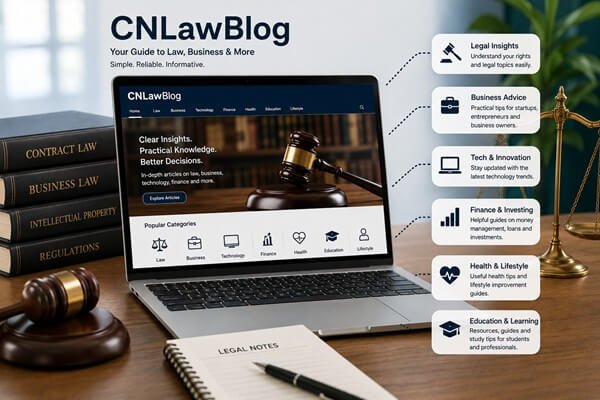
After looking across the current search results, the safest explanation is that CNLawBlog is used as the name of online publishing and legal-information websites, but the search results do not point to one universally established legal institution behind the name. The current CNLawBlog.com website describes itself as an independent online publication covering law, technology, business, finance, health, education, and other subjects.
Other sites using the name take a more specific approach. One describes CNLawBlog as a platform for Chinese law and cross-border business, while another uses the name for a much broader blog covering technology, lifestyle and business topics.
So, if you came across CNLawBlog in Google and want to know what it means, this guide will help you separate the different versions of the name, understand what the websites publish, and decide how much trust to place in information you find there.
What Is CNLawBlog?
CNLawBlog is an online publishing name associated with legal and informational content.
The current CNLawBlog.com website says it is an independent online publication that publishes content across law, technology, business, finance, health, education, and other subjects. Its homepage also features articles on topics such as AI, gaming, personal finance, loans, health, technology, and home improvement.
That is broader than the name might suggest.
Someone seeing “CN Law Blog” for the first time might assume the website only discusses Chinese law. That assumption is understandable, but the current search results show that the name is being used in several different ways.
One CNLawBlog site presents itself specifically around Chinese legal topics. It discusses areas such as China’s Personal Information Protection Law, cybersecurity rules, licensing, intellectual property and cross-border data issues.
Another CNLawBlog website describes itself as a general legal resource covering areas such as family law, criminal defense and business law. At the same time, its published posts also include subjects that are not strictly legal, such as property rentals, immigration investment and technology.
This is why the domain matters when researching CNLawBlog.
The name alone is not enough to tell you exactly which website you are reading.
Why Are There Different CNLawBlog Websites?
This is probably the most important thing to understand before reading anything about CNLawBlog.
Search results currently show multiple domains using the CNLawBlog name or a very similar variation.
Examples include:
- CNLawBlog.com
- CNLawBlog.org
- CNLawBlog.co.uk
- CNLawBlogs.com
- Other websites publishing articles about CNLawBlog
These websites should not automatically be treated as one organization.
For example, CNLawBlog.com describes itself as an independent online publication with a broad subject range.
CNLawBlog.co.uk describes itself as a legal information resource but currently publishes articles under categories including law, technology, real estate and lifestyle.
CNLawBlog.org has an even broader magazine-style structure, with categories such as technology, business, lifestyle and home improvement.
There is also a separate CNLawBlogs.com website that focuses much more specifically on Chinese business law and offers tools relating to compliance, privacy, licensing and Chinese legal terminology.
The takeaway is simple:
Do not assume that every website using the CNLawBlog name belongs to the same company, legal team or editorial organization.
Always check the actual domain.
Is CNLawBlog an Official Government Legal Website?
There is no strong evidence in the current search results showing that CNLawBlog is a government legal authority, court database, or official government law portal.
That distinction is important.
A legal blog can explain laws without being an official source of law.
For example, a website might explain a new regulation in simple language. That explanation can be useful, but the actual regulation should still be checked against the relevant government publication or official legal database before someone relies on it for an important decision.
One independent review specifically notes that it found no verified evidence connecting CNLawBlog with a government body, court, university project, or established legal institution.
That does not automatically mean that everything published under the CNLawBlog name is wrong.
It simply means readers should distinguish between legal information and official legal authority.
That is a good rule for almost every legal blog on the internet.
Is CNLawBlog a Law Firm?
The available information does not establish CNLawBlog as a conventional law firm.
Some search results describe it as an independent legal-information or publishing platform rather than a firm representing clients.
That difference matters.
A law firm normally provides professional legal services through qualified lawyers.
A legal blog generally provides educational or informational material.
If you are reading an article about a contract, immigration matter, business dispute, criminal case, property issue or another serious legal problem, an online article should not be treated as a substitute for advice from a qualified lawyer who understands your specific situation.
What Topics Does CNLawBlog Cover?
The answer depends on which CNLawBlog website you mean.
The current CNLawBlog.com website says it covers a broad collection of subjects, including:
- Law
- Technology
- Business
- Finance
- Health
- Education
- Lifestyle
- Other informational topics
Its recent content includes articles about AI, gaming, screen time, loans and business-related subjects.
Other CNLawBlog websites focus more heavily on legal topics.
The Chinese-law-focused CNLawBlogs.com site discusses areas such as:
- Data privacy
- PIPL compliance
- Cybersecurity
- Intellectual property
- Foreign investment
- Licensing
- Cross-border data transfers
- Chinese legal terminology
So the topic range can be quite different depending on the domain.
CNLawBlog and Chinese Law
The “CN” in CNLawBlog naturally leads many readers to think about China.
There is good reason for that interpretation because several current search results connect the name with Chinese law.
CNLawBlogs.com, for example, specifically presents content for business owners, investors and professionals dealing with Chinese legal rules. Its website includes topics such as PIPL, cybersecurity, foreign investment and data regulations.
Other articles describing CNLawBlog also connect it with Chinese law and cross-border business.
However, it would be too broad to say that every CNLawBlog website is a Chinese-law website.
The current CNLawBlog.com site has a much wider editorial focus.
This is another reason why checking the domain and article author is important.
What Is PIPL and Why Does It Appear in CNLawBlog Searches?
If you encounter a CNLawBlog page discussing Chinese privacy law, you may see the term PIPL.
PIPL stands for China’s Personal Information Protection Law.
It is an important part of China’s data-protection framework and is particularly relevant to businesses handling personal information in China.
A business dealing with customers, employees or users in China may need to understand requirements surrounding the collection and processing of personal information.
This is the type of subject where a plain-language legal article can be useful.
But businesses should not stop at a blog article when dealing with compliance.
The actual law, regulations, official guidance and professional advice are more important when making a real compliance decision.
CNLawBlog for Business Owners
Legal information is particularly useful for small businesses because owners often face legal questions before they have an internal legal department.
Common questions include:
- How should a contract be written?
- What happens when a customer does not pay?
- What rules apply to employee data?
- How can intellectual property be protected?
- What licenses are required?
- How should a business handle privacy requirements?
- What happens when a company works across borders?
A good legal article can help a business owner understand the basic issue before speaking with a lawyer.
That is one of the strongest reasons to use legal blogs.
They can help you learn the vocabulary first.
Instead of going into a consultation and saying, “I have a problem with data,” you may already understand that the issue involves privacy, consent, cross-border transfers or another specific area.
That can make the conversation with a lawyer much more productive.
CNLawBlog for Students
Students can also use legal blogs as a starting point when learning unfamiliar subjects.
Legal textbooks can be difficult when you’re encountering a concept for the first time.
A simple article can provide the basic idea before you move on to legislation, case law or academic material.
For example, a student researching corporate law may first want to understand what a particular type of company does.
A student researching privacy law may want a simple explanation of data protection.
A student researching international business may need an introduction to foreign investment rules.
CNLawBlog-style explanatory content can be useful at this early stage.
But students should be careful about citing blogs as if they were primary legal authorities.
For serious academic work, primary sources and reputable legal publications are usually much stronger references.
CNLawBlog for General Readers
You do not have to be a lawyer to search for legal information.
People often search legal topics because something has happened in their everyday life.
Maybe they received a letter.
Maybe they are signing a lease.
Maybe they are starting a business.
Maybe they are dealing with an employment problem.
Maybe they are trying to understand a contract.
The internet can provide the first explanation.
This is where the simple-language approach used by many CNLawBlog articles can be useful.
The goal should be to understand the issue, not to convince yourself that one article has already solved your legal problem.
How to Tell Whether a CNLawBlog Article Is Useful
A useful legal article should make it easy to answer several basic questions.
Who wrote it?
Look for an author name and, when appropriate, professional qualifications.
When was it published?
Law changes. An article from several years ago may not reflect the current rules.
Has it been updated?
A visible update date can be useful when regulations change frequently.
Does it cite sources?
Look for references to legislation, government websites, court decisions, official guidance or recognized legal sources.
Does it explain its limits?
A responsible informational article should not pretend that a general explanation automatically applies to every person’s situation.
These checks are more useful than simply trusting a page because it appears on the first page of Google.
Why Search Rankings Are Not Proof of Legal Accuracy
This point is easy to forget.
Google ranking and legal authority are two different things.
A page can rank highly because it has good search optimization, strong links, useful content or simply because there is little competition for the keyword.
That does not make the website a court, government agency or law firm.
The current search results for CNLawBlog demonstrate this clearly.
Several different websites publish pages about the same keyword, and their descriptions do not always agree.
Some present CNLawBlog as a legal platform.
Others present it as a broad publishing website.
One describes the term as unclear and says there is insufficient evidence to establish one official meaning.
That is why a careful reader should look beyond the search snippet.
Is CNLawBlog Reliable?
There isn’t a single yes-or-no answer that applies to every website using the name.
The more accurate answer is:
Treat CNLawBlog as an informational starting point, and verify important legal claims with primary sources or a qualified legal professional.
Some current CNLawBlog pages describe themselves as research-driven and focused on simplifying complex legal subjects.
An independent review, however, points out that the identity, ownership and legal credentials behind some CNLawBlog references are not clearly established.
Another review describes CNLawBlog as an independent legal blog rather than a law firm or government resource and recommends cross-checking information before making important decisions.
Those differences are exactly why readers should evaluate the individual website and article rather than making a blanket judgment about the entire name.
A Simple Way to Use CNLawBlog
If you find a useful CNLawBlog article, you can use it in three stages.
First: Learn the Basic Idea
Read the article to understand the terminology.
If you don’t know what PIPL, FDI, intellectual property or a particular legal concept means, the article may give you a useful starting point.
Second: Find the Primary Source
Once you understand the subject, look for the actual law, regulation, government guidance or court decision.
This is where you confirm the details.
Third: Get Professional Advice When the Stakes Are High
If the decision involves substantial money, a legal dispute, immigration, criminal liability, business compliance or another serious matter, speak with a qualified lawyer.
The blog helps you understand the question.
The lawyer helps you apply the law to your particular circumstances.
CNLawBlog and Guest Contributions
Another theme appearing in search results is guest publishing.
One article describes CNLawBlog as a platform that has been associated with guest blogging and content contributions.
This is worth mentioning because the presence of guest content can affect how readers evaluate an article.
If a website publishes material from many contributors, don’t assume every author has the same expertise.
Look at the individual byline.
Check the author’s background.
Check whether the article includes sources.
This is especially important for legal, financial and health topics.
A strong website can publish a useful article from one contributor while another article may be less authoritative.
The author and evidence matter.
Why CNLawBlog Appears in So Many Search Results
The keyword has attracted a surprisingly large number of articles.
Several results from 2026 are specifically written to explain CNLawBlog itself.
That creates a circular search experience.
One website writes about CNLawBlog.
Another website reads that article and publishes its own explanation.
A third site does the same.
Eventually, Google has many pages discussing the same term, even though the original source may not be clearly established.
This is why readers should be careful when they see the same statement repeated on several websites.
Five websites repeating the same sentence does not necessarily mean there are five independent sources.
The information may have originated from one article.
What Makes a Good Legal Blog?
Regardless of the CNLawBlog domain, the same basic standards apply to legal publishing.
A good legal blog should aim for:
Clear writing.
Readers should understand the point without needing a law degree.
Current information.
Old legal information can become misleading after a new law or court decision.
Good sources.
Important claims should be traceable to legislation, cases, government material or reputable legal references.
Qualified contributors.
Legal subjects benefit from writers who understand the area they are discussing.
Honest limitations.
A general article should not pretend to provide personalized legal advice.
Useful examples.
Realistic examples can make complicated rules easier to understand.
These qualities matter more than the website’s name.
Should You Use CNLawBlog for Legal Research?
Yes, but use it at the right level.
For basic learning, a clear legal blog can be very useful.
For initial research, it can help you discover terminology and questions you should investigate.
For important legal decisions, don’t stop there.
Use official sources and professional advice.
Think of an online legal article as the beginning of your research rather than the final answer.
That approach is safer and usually more useful.
CNLawBlog vs Official Legal Sources
There is a major difference between the two.
A blog explains.
An official legal source establishes or publishes the authoritative material.
For example, if a blog says that a particular regulation changed, you should be able to find the underlying regulation or official announcement.
This is especially important when the law is changing quickly.
A blog may simplify a rule for readability, but simplification can sometimes leave out exceptions.
Those exceptions can be extremely important in real cases.
Frequently Asked Questions About CNLawBlog
What is CNLawBlog?
CNLawBlog is a name used by online legal and informational publishing websites. The current CNLawBlog.com site describes itself as an independent publication covering law, technology, business, finance, health, education and other subjects.
Is CNLawBlog an official legal website?
There is no verified evidence in the current search results that the CNLawBlog name represents a government legal authority or court database. One independent review specifically says that no official government affiliation could be verified.
Is CNLawBlog a law firm?
The available information does not establish CNLawBlog as a traditional law firm. It is more appropriately treated as an online information or publishing resource unless a specific domain clearly identifies a separate legal practice.
Does CNLawBlog focus on Chinese law?
Some websites using the CNLawBlog name specifically focus on Chinese law, including privacy, cybersecurity, foreign investment and intellectual property. However, other CNLawBlog websites publish much broader content.
Why does CNLawBlog appear in Google?
The term is currently used across multiple websites and has generated a growing number of explanatory articles. Several 2026 search results specifically target the keyword and explain what CNLawBlog supposedly is.
Is information on CNLawBlog reliable?
It can be useful as general information, but reliability should be judged article by article. Check the author, date, sources and underlying legal authority before relying on a claim.
Can CNLawBlog replace a lawyer?
No. An online article can explain a legal concept, but it cannot understand every fact in your situation or provide the same service as a qualified lawyer.
Is every CNLawBlog website the same?
No. Search results show several domains using the CNLawBlog name or variations of it. Their topics and descriptions differ.
Is CNLawBlog useful for business owners?
It can be useful for learning about business-related legal subjects, especially when an article explains a complicated issue in plain language. For actual compliance or legal decisions, businesses should verify the information through authoritative sources and professional advice.
Can students use CNLawBlog?
Yes, as a starting point for understanding legal concepts. Students should still use primary sources, academic publications and recognized legal references when preparing serious research.
Should I trust a CNLawBlog article just because it ranks on Google?
No. Search ranking is not proof of legal authority. Check the sources behind the article.
The Bottom Line
The phrase CNLawBlog looks simple, but the current search results show that it has several meanings online.
Some websites use the name for legal information.
Some focus specifically on Chinese law and cross-border business.
Others have developed into broad publishing sites covering technology, business, finance, health, lifestyle and education.
That makes one thing especially important: check the domain before assuming you know what CNLawBlog refers to.
If you are simply trying to understand a legal topic, a well-written CNLawBlog article may be a useful place to start. It can explain difficult terms, give you background and help you work out what questions you need to ask.
But don’t confuse a blog with an official legal authority.
For anything that could seriously affect your money, business, rights, immigration status, employment, property or legal position, go one step further. Find the underlying law or official guidance, check the date, and speak with a qualified legal professional when necessary.
The best way to use CNLawBlog is therefore not to treat it as the final word.
Use it to understand the subject. Then verify the important details.
That simple approach gives you the benefit of easy-to-read online information without putting too much trust in a single search result.