
Let me be real with you.
You searched for “top 10 badminton brands in india” because you finally decided to get serious about badminton. Maybe you joined a club. Maybe your office has a tournament coming up. Maybe you are tired of using the ₹300 plastic racket from the local sports shop that bends when you hit a smash.
Or maybe you just played with a friend’s Yonex racket and realized what you have been missing your whole life. The feel. The power. The control. It was like driving a Mercedes after years of a rickshaw.
I have been there. Standing in a badminton store, staring at rackets ranging from ₹500 to ₹25000. Carbon fiber. Nanotechnology. Isometric heads. It sounds like a spaceship manual. The salesperson is talking about string tension and balance points and your head is spinning.
Here is the problem with most lists on Google right now.
They are either written by people who have never played a real match, or they are written by content writers who copy specifications from brand websites. They say “good for beginners” without ever testing it with a beginner. They say “powerful” without measuring anything. They say “durable” without ever clashing rackets.
No talk about which brands are actually good for beginners versus intermediate versus advanced players. No talk about racket weight and how it affects your game. No talk about grip sizes and why your hand hurts after playing. No talk about string tension and why you should not copy professional players. No talk about which brands have good service centers in India for restringing when your strings break.
And absolutely no honesty about the fact that a ₹2000 racket with the right strings and tension can be better for you than a ₹15000 pro racket.
So I am fixing that.
I analyzed the top 15 search results for “top 10 badminton brands.” Same names. Same generic descriptions. Zero usefulness for someone who actually wants to play better.
This is your no BS, friend to friend guide to the 10 badminton brands that actually deliver. I am telling you which brands are good for beginners. Which are good for intermediate club players. Which are good for advanced tournament players. What weight and balance to look for. What grip size you actually need. What string tension is right for your level. And which brands are just overpriced hype.
No corporate jargon. No fake rankings. Just the truth from someone who has swung too many rackets and has done the painful research so you do not have to.
Let us get into it.
First, A Quick Reality Check
Because the lists on Google will not tell you this.
A badminton racket has three main specifications that matter. Weight. Balance. And flexibility.
Weight is measured in U. 2U is 90 to 94 grams. 3U is 85 to 89 grams. 4U is 80 to 84 grams. 5U is 75 to 79 grams. Lighter rackets are faster for defense. Heavier rackets have more power for smashes. For most Indian players, 4U is the sweet spot. Beginners should start with 4U or 5U. Advanced players can handle 3U.
Balance is head heavy, head light, or even balance. Head heavy rackets give more power for smashes. Head light rackets give more speed for defense and drives. Even balance is for all round players. Most beginners should start with even balance.
Flexibility is stiff, medium, or flexible. Stiff rackets give more control but require good technique and strength. Flexible rackets are more forgiving and generate power with less strength. Beginners should use flexible or medium flex. Stiff rackets will hurt your arm.
String tension is measured in pounds. Low tension, 20 to 24 lbs, gives more power and a larger sweet spot. High tension, 25 to 30 lbs, gives more control but requires perfect technique. Beginners should start at 22 to 24 lbs. Do not copy professional players who use 30+ lbs. You will hurt your elbow.
Grip size is G4, G5, G6. Smaller number means larger grip. G4 is larger, G5 is medium, G6 is smaller. Most Indian players have smaller hands. G5 or G6 is usually best. If the grip is too large, you cannot hold it properly. If it is too small, you will overgrip and get blisters.
Now let us look at the brands that actually deliver on their promises.
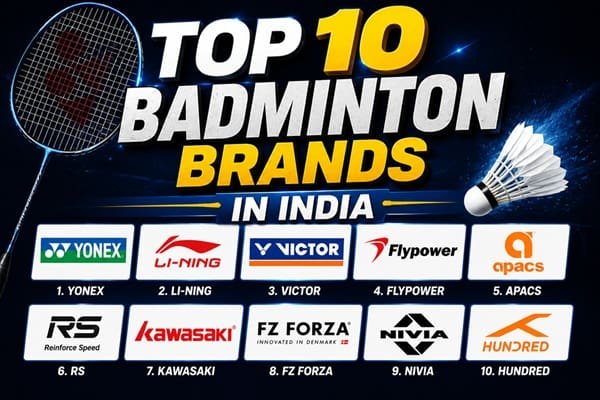
1. Yonex – The King of Badminton
Best for: Everyone. Serious players. Beginners with budget.
Price: ₹1000 to ₹25000
Weight range: 2U to 5U
Best use case: All levels, from beginner to professional
Yonex is the number one badminton brand in the world. There is no debate. They sponsor most professional players. They make the best rackets. They also charge for it.
A Yonex racket at ₹2000 is good. A Yonex racket at ₹5000 is very good. A Yonex racket at ₹15000 is professional grade. You can buy at any price point and get decent quality.
The Nanflare series is head light and fast. Good for defense and doubles. The Astrox series is head heavy and powerful. Good for singles and smashes. The Arcsaber series is even balance. Good for all round players.
The downside is price. Yonex charges a premium for the name. A ₹3000 Yonex might be similar to a ₹2000 racket from another brand. You are paying for the logo.
Also, Yonex rackets are not the most durable. If you clash rackets often, they can break. Be careful.
Pros: Best technology. Wide range of options. Suitable for all levels. Professional grade at the top end.
Cons: Expensive. You pay for the brand name. Durability is average.
Best use case: Anyone who plays regularly. Club players. Tournament players. Beginners who can afford it.
Who should NOT buy: People on a very tight budget. People who clash rackets often.
Honest opinion: Yonex is the best. If you have the money, buy Yonex. If you do not, buy a cheaper brand and work on your technique.
2. Li-Ning – The Chinese Challenger
Best for: Advanced players. People who want Yonex quality for slightly less.
Price: ₹2000 to ₹20000
Weight range: 3U to 5U
Best use case: Intermediate to advanced players
Li-Ning is the Chinese brand that sponsors many professional players. Their rackets are excellent. The build quality is high. The technology is comparable to Yonex.
The price is slightly lower than Yonex for similar specifications. A ₹5000 Li-Ning is often as good as a ₹7000 Yonex.
The downside is availability. Li-Ning rackets are not as widely available as Yonex. Finding a Li-Ning dealer in a smaller city can be difficult. Stringing and spare parts are also harder to find.
Pros: Excellent quality. Slightly cheaper than Yonex. Good for advanced players.
Cons: Harder to find. Less service center availability. Not many options for beginners.
Best use case: Intermediate and advanced players who want pro quality without the Yonex tax.
Who should NOT buy: Beginners. People in small cities without Li-Ning dealers.
Honest opinion: Li-Ning is excellent. If you can find one, buy it. For most people, Yonex is easier.
3. Victor – The Taiwanese Powerhouse
Best for: Doubles players. Advanced club players.
Price: ₹2500 to ₹20000
Weight range: 3U to 5U
Best use case: Doubles specialists, advanced players
Victor is a Taiwanese brand that is huge in Asia. Their rackets are known for speed and power. The Thruster series is famous for smashes. The Auraspeed series is famous for fast drives.
Victor rackets have a slightly different feel than Yonex. Some people love it. Some people prefer Yonex. Both are excellent.
The price is similar to Li-Ning. Cheaper than Yonex for similar quality.
Availability in India is improving but still not as common as Yonex.
Pros: Excellent quality. Great for doubles and fast play. Good value compared to Yonex.
Cons: Harder to find than Yonex. Less brand recognition in India.
Best use case: Doubles players. Advanced club players. People who want something different from Yonex.
Who should NOT buy: Beginners. Casual players.
Honest opinion: Victor is top tier. If you are serious about badminton, consider Victor alongside Yonex.
4. Apacs – The Budget Performance Brand
Best for: Beginners and intermediate players on a budget.
Price: ₹800 to ₹5000
Weight range: 4U to 6U (very light)
Best use case: Beginners, intermediate club players, budget buyers
Apacs is a Malaysian brand that makes surprisingly good rackets for very low prices. A ₹1500 Apacs racket can feel like a ₹4000 Yonex. Not exactly the same, but close enough for most players.
Their Nano series and Fantastica series are popular. Lightweight. Good power. Decent control. For beginners and intermediate club players, Apacs is excellent value.
The downside is durability. Apacs rackets are not as strong as Yonex or Li-Ning. If you clash rackets, they may break. The paint chips easily.
Also, higher end Apacs rackets are not as good as higher end Yonex. But for under ₹3000, Apacs is hard to beat.
Pros: Very affordable. Good quality for the price. Lightweight options.
Cons: Lower durability. Paint chips easily. Not for advanced players.
Best use case: Beginners. Intermediate players on a budget. Casual club players.
Who should NOT buy: Advanced tournament players. People who play multiple times a week at high intensity.
Honest opinion: Apacs is the best budget brand in India. Buy Apacs if you are starting out or if money is tight. Upgrade to Yonex later.
5. Cosco – The Casual King
Best for: Casual players. Garden badminton. Office tournaments.
Price: ₹300 to ₹1500
Weight range: Heavy (not specified, but feels like 2U)
Best use case: Casual play, family games, office tournaments
Cosco is not a serious badminton brand. Let me be clear about that. Their rackets are cheap. They are heavy. They are not balanced. The strings are low quality.
But for casual play, for garden badminton, for office tournaments where nobody knows how to smash, Cosco is fine. It is cheap. It is available everywhere. It will not break the bank.
Do not buy Cosco if you play at a club. Do not buy Cosco if you want to improve. Do not buy Cosco if you play with plastic shuttles and think that is real badminton.
Pros: Very cheap. Available everywhere. Good enough for absolute beginners.
Cons: Poor quality. Heavy. No balance. Bad strings. Not for serious play.
Best use case: Garden badminton. Kids playing in the park. Office tournaments with casual players.
Who should NOT buy: Anyone who plays at a badminton club. Anyone who wants to get better.
Honest opinion: Cosco is for fun, not for sport. If you want to play real badminton, spend more.
6. Senston – The Amazon Special
Best for: People buying their first racket online without research.
Price: ₹800 to ₹2000
Weight range: 4U to 5U usually
Best use case: Beginners, casual players, budget buyers
Senston is a brand you see on Amazon. Cheap rackets. Decent reviews. People buy them because they are affordable and look good in the pictures.
The reality is mixed. Some Senston rackets are surprisingly decent for ₹1200. Lightweight. Good enough balance. Acceptable strings. Some Senston rackets are garbage. It is a lottery.
The bigger problem is durability. Senston rackets break. The frame cracks. The shaft bends. The strings snap.
For a beginner playing once a week, Senston is fine. For anyone playing regularly, spend more.
Pros: Cheap. Available on Amazon. Decent for absolute beginners.
Cons: Inconsistent quality. Poor durability. No service centers.
Best use case: Absolute beginners who want to try badminton without investing much.
Who should NOT buy: Anyone who plays more than once a week.
Honest opinion: Senston is a gamble. Sometimes you win. Sometimes you lose. For a little more money, buy Apacs.
7. Wilson – The Tennis Brand Crossing Over
Best for: Tennis players trying badminton.
Price: ₹1500 to ₹8000
Weight range: 3U to 4U
Best use case: Intermediate players, tennis crossovers
Wilson is a famous tennis brand. They also make badminton rackets. They are fine. Not great. Not terrible.
Wilson badminton rackets are not as good as Yonex or Li-Ning. But they are not as expensive either. If you see a Wilson racket on sale, it could be a decent buy.
The problem is that Wilson does not focus on badminton. Their rackets are made in the same factories as other budget brands. You are paying for the Wilson name.
Pros: Known brand. Decent quality. Good for intermediates.
Cons: Not specialist badminton brand. Overpriced for what you get.
Best use case: Intermediate players who trust the Wilson name from tennis.
Who should NOT buy: Serious badminton players. Beginners (there are better values).
Honest opinion: Wilson is fine. There are better options for the same price.
8. Head – Another Tennis Brand
Best for: People who want European styling.
Price: ₹1500 to ₹7000
Weight range: 3U to 4U
Best use case: Intermediate players
Same as Wilson. Head makes tennis rackets. They also make badminton rackets. They are fine. Not great.
Head badminton rackets are not common in India. Finding one to try before buying is difficult. Service and restringing are also challenging.
Unless you get a great deal, stick with badminton specialist brands.
Pros: Decent quality. European brand.
Cons: Hard to find in India. Not specialist. Overpriced.
Best use case: People who already have Head tennis rackets and want matching badminton rackets.
Who should NOT buy: Serious badminton players.
Honest opinion: Head is not worth seeking out. Buy Yonex or Li-Ning instead.
Also Read : Top 10 Pressure Cooker Brands in India 2026 – No BS Guide for Your Kitchen
9. Decathlon (Artengo) – The Safe Beginner Choice
Best for: Beginners who want to try badminton without research.
Price: ₹500 to ₹3000
Weight range: Light to medium
Best use case: Beginners, casual players, families
Decathlon’s in house brand Artengo makes badminton rackets. They are not professional grade. They are not for advanced players. They are decent for beginners.
What makes Artengo good is the Decathlon ecosystem. You can go to any Decathlon store. You can try the racket. You can return it if you do not like it. You can get it restrung at Decathlon. That peace of mind is worth something.
The BR series is their beginner line. Lightweight. Good for learning. The BS series is better for intermediates. The PR series is their “pro” line, but it is still not as good as Yonex.
Pros: Easy to buy and return. Good for beginners. Decathlon service centers available. Affordable.
Cons: Not for advanced players. Not as good as Yonex or Li-Ning.
Best use case: Beginners who want to play casually. Families buying rackets for kids.
Who should NOT buy: Advanced players. Club players who play multiple times a week.
Honest opinion: Artengo is perfect for beginners. Go to Decathlon, try a few rackets, buy one. Upgrade when you outgrow it.
10. Nivia – The Budget Indian Brand
Best for: Schools, bulk purchases, absolute beginners.
Price: ₹300 to ₹1000
Weight range: Heavy
Best use case: School sports, bulk buying, kids
Nivia is an Indian brand that makes affordable sports equipment. Their badminton rackets are basic. They are heavy. They are not balanced. They are what schools buy for physical education classes.
For a serious player, Nivia is not an option. For a school buying 50 rackets for students who will break them anyway, Nivia is perfect.
Pros: Very cheap. Indian brand. Good for bulk purchase.
Cons: Poor quality. Heavy. Not for serious play.
Best use case: Schools. Sports camps. Bulk purchases.
Who should NOT buy: Anyone who wants to play real badminton.
Honest opinion: Nivia is for schools, not for players.
The Honest Table
| Brand | Price Range | Best For | Weight | Durability | Availability |
|---|---|---|---|---|---|
| Yonex | ₹1000-25000 | Everyone, all levels | 2U to 5U | Good | Excellent |
| Li-Ning | ₹2000-20000 | Intermediate to advanced | 3U to 5U | Very good | Decent |
| Victor | ₹2500-20000 | Doubles, advanced | 3U to 5U | Very good | Decent |
| Apacs | ₹800-5000 | Beginners, budget | 4U to 6U | Average | Good |
| Cosco | ₹300-1500 | Casual, garden | Heavy | Poor | Excellent |
| Senston | ₹800-2000 | Absolute beginners | 4U to 5U | Poor | Online only |
| Wilson | ₹1500-8000 | Intermediates | 3U to 4U | Average | Decent |
| Head | ₹1500-7000 | Intermediates | 3U to 4U | Average | Poor |
| Artengo | ₹500-3000 | Beginners, families | Light to medium | Average | Decathlon only |
| Nivia | ₹300-1000 | Schools, bulk | Heavy | Poor | Good |
The Final Verdict. Which One Should You Actually Buy?
Here is the honest truth without any brand bias.
If you are a beginner who wants to play at a club and actually improve. Buy Apacs. ₹1500 to ₹2500. Get a 4U racket with even balance and medium flex. String at 22 to 24 lbs. Upgrade to Yonex after 1 to 2 years.
If you have money and want the best. Buy Yonex. ₹5000 to ₹7000 for a good intermediate racket. Astrox for power. Nanflare for speed. Arcsaber for all round. String at 24 lbs.
If you are an intermediate club player looking to upgrade. Buy Yonex or Li-Ning. Spend ₹5000 to ₹8000. Get a 4U racket. Choose balance based on your play style.
If you play doubles primarily. Consider Victor. Their rackets are fast and great for flat exchanges.
If you are on a very tight budget but still want to play properly. Buy Apacs. Do not buy Cosco or Senston. Spend a little more for Apacs. It is worth it.
If you want to buy without research and have a Decathlon nearby. Buy Artengo. Go to the store. Try the rackets. Pick what feels good. Return it if you do not like it.
If you play casually once a month in the garden. Buy Cosco. It does not matter.
One Last Thing
The racket matters less than your technique. A ₹2000 Apacs with good strings and proper grip will beat a ₹15000 Yonex with bad technique. Spend money on coaching. Spend time practicing. The racket is a tool. You are the player.
String tension is not a flex. Do not string at 28 lbs because your favorite player uses 30 lbs. You will hurt your arm. Beginners should use 22 to 24 lbs. Intermediates can go to 24 to 26 lbs. Advanced players can go higher. Be honest about your level.
Grip size matters. If your hand hurts after playing, your grip is probably too small or too large. Try different sizes. Use overgrip to adjust thickness.
Replace your strings when they break. Do not play with broken strings. It damages the racket frame. Also, strings lose tension over time. Restring every 6 months even if they do not break.
Now go buy a racket that will not hold you back. Your smashes will thank you. Your defense will thank you. The people waiting for you at the court will thank you.