
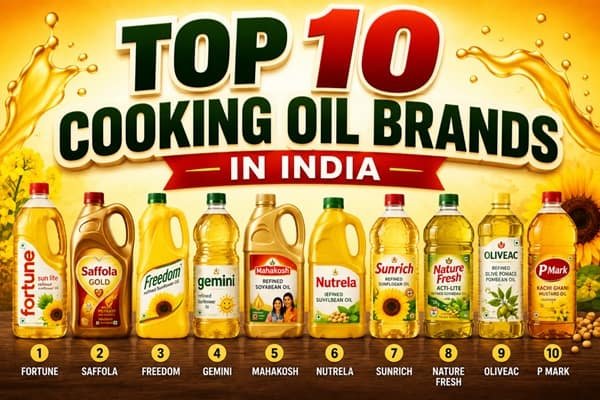
Let me be real with you.
You searched for “top 10 cooking oil brands” because you are confused. Every brand says “heart healthy.” Every bottle says “rich in MUFA.” Every ad shows a happy family with no health problems. Meanwhile, your mother still insists on using the same coconut oil she has used for 40 years. Your wife wants rice bran oil. Your gym trainer says olive oil only. You just want to make some aloo paratha without having a existential crisis.
I have been there. Standing in the cooking oil aisle, staring at 50 different bottles. Fortune. Saffola. Dhara. Sundrop. Patanjali. Some in plastic. Some in metal. Some in glass. Prices from ₹80 per liter to ₹500 per liter. The label says “healthy” and “pure” and “natural.” They cannot all be the best.
Here is the problem with most lists on Google right now.
They are either written by nutritionists who have never cooked a meal in their life, or they are written by content writers who copy from brand websites. They say “heart healthy” without explaining what that means. They say “rich in antioxidants” without telling you that heat destroys most antioxidants. They say “high smoke point” without telling you that smoking oil is carcinogenic.
No talk about which oils are actually safe for deep frying at 180 degrees. No talk about which oils are adulterated with cheap palm oil (common in India). No talk about which oils are good for tempering versus sautéing versus salad dressing. No talk about which oils go rancid quickly and should be bought in small bottles. No talk about which oils are actually made in India versus imported and rebottled.
And absolutely no honesty about the fact that all oils are fat. All oils have calories. No oil is a “health food.” Some are just less bad than others.
So I am fixing that.
I analyzed the top 15 search results for “top 10 cooking oil brands.” Same names. Same generic descriptions. Zero usefulness for someone who actually wants to cook.
This is your no BS, friend to friend guide to the 10 cooking oil brands that actually deliver. I am telling you which oils are good for deep frying. Which are good for daily cooking. Which are good for heart health. Which are good for skin and hair. Which oils have been caught adulterating. Which oils are worth the premium price. And which are just expensive bottles of the same stuff.
No corporate jargon. No fake rankings. Just the truth from someone who has cooked thousands of meals and has done the painful research so you do not have to.
Let us get into it.
First, A Quick Reality Check
Because the lists on Google will not tell you this.
Every cooking oil is a blend of different types of fats. Saturated fat, monounsaturated fat (MUFA), and polyunsaturated fat (PUFA). Saturated fat is stable for high heat but bad for cholesterol in large amounts. MUFA is heart healthy and moderately stable. PUFA is heart healthy but very unstable at high heat.
The smoke point is the temperature at which oil starts smoking. When oil smokes, it releases toxic compounds and free radicals. Do not cook above the smoke point. For deep frying at 170 to 190 degrees, you need oil with a smoke point above 200 degrees.
Refined oils have higher smoke points but fewer nutrients. Cold pressed oils have more nutrients but lower smoke points. Do not deep fry with cold pressed oil. You will burn it and poison yourself.
Most “heart healthy” claims are marketing. Any oil that is low in saturated fat and high in unsaturated fat is “heart healthy.” That includes most vegetable oils. The real question is stability at high heat.
Many cheap oils in India are adulterated with palm oil. Palm oil is cheap, high in saturated fat, and bad for your heart in large amounts. Some brands cut their “pure” oils with palm. There have been lab tests. I have included findings.
Now let us look at the brands that actually deliver on their promises.
1. Fortune – The King of Indian Kitchens
Best for: Daily cooking. All purpose use.
Price: ₹100 to ₹150 per liter
Smoke point: Around 200 degrees (good for most cooking)
Best use case: Everyday curries, stir fry, sautéing
Fortune is the largest cooking oil brand in India. Every kitchen has it. Every store has it. Every family has used it. They are the Maruti Suzuki of cooking oils.
Fortune’s main product is Fortune Rice Bran Oil. It has a high smoke point, around 250 degrees, which makes it safe for deep frying and high heat cooking. It is neutral in taste, so it does not change the flavor of your food. It has a good fatty acid profile for heart health.
The downside is that Fortune oils are highly refined. The refining process removes many nutrients. You are getting a stable, neutral, affordable oil. You are not getting a health tonic.
Fortune also has blended oils like Fortune Vivo (rice bran + soybean) and Fortune Sunlite (sunflower + rice bran). These are cheaper but have lower smoke points.
Pros: Available everywhere. Affordable. High smoke point. Neutral taste. Good for daily cooking.
Cons: Highly refined, low nutrients. Some variants have palm oil. Not for raw consumption like salad dressing.
Best use case: Daily Indian cooking. Curries. Subzi. Deep frying pakoras. Parathas.
Who should NOT buy: People who want cold pressed oil. People who want oil for raw use.
Honest opinion: Fortune is the safe, boring, reliable choice. Buy it for daily cooking. Do not overthink it.
2. Saffola – The Heart Health King
Best for: People with heart concerns. Health conscious buyers.
Price: ₹130 to ₹180 per liter
Smoke point: Around 220 degrees
Best use case: Daily cooking, heart health
Saffola is owned by Marico. Their entire brand is built on heart health. The ads show doctors. The labels have heart diagrams. The messaging is all about cholesterol.
Saffola Total is their flagship product. It is a blend of rice bran oil and safflower oil, with added antioxidants. The fatty acid ratio is balanced specifically for heart health. Independent studies have shown it can help lower bad cholesterol.
The smoke point is good for deep frying and high heat cooking. The taste is neutral.
The downside is the price. Saffola is more expensive than Fortune. You are paying for the marketing and the “heart health” positioning.
Pros: Good fatty acid ratio. High smoke point. Neutral taste. Good for heart health.
Cons: Expensive. Highly refined. You are paying for marketing.
Best use case: Families with heart disease history. Health conscious buyers. Daily cooking.
Who should NOT buy: People on a tight budget. People who want cold pressed oil.
Honest opinion: Saffola is good oil. Is it worth the premium over Fortune? Maybe. If heart health is a concern, spend the extra money. If not, Fortune is fine.
3. Dhara – The Old Government Brand
Best for: People who trust old brands. Budget buyers.
Price: ₹90 to ₹140 per liter
Smoke point: Around 200 degrees
Best use case: Daily cooking, budget kitchens
Dhara is a brand from NDDB, the cooperative that brought us Amul. It has been around for decades. Your parents probably used it.
Dhara’s mustard oil and soybean oil are popular. Their refined vegetable oil is a blend of multiple oils. It is cheap. It works. It is not special.
The problem is that Dhara has been inconsistent in quality over the years. Some batches are good. Some are not. There have been reports of adulteration in the past.
For the price, it is fine. But do not expect premium quality.
Pros: Cheap. Available everywhere. Trusted old name.
Cons: Inconsistent quality. Adulteration reports in past. Highly refined.
Best use case: Budget daily cooking. Large families who use a lot of oil.
Who should NOT buy: People who want consistent quality. People with heart concerns.
Honest opinion: Dhara is fine for the price. If you are on a tight budget, buy it. If you can afford better, buy Fortune or Saffola.
4. Sundrop – The Sunflower Specialist
Best for: Light cooking. People who want a lighter taste.
Price: ₹100 to ₹150 per liter
Smoke point: Around 210 degrees
Best use case: Light sautéing, salad dressings, baking
Sundrop is known for sunflower oil. Sunflower oil is light in taste and light in color. It does not overpower food. It is good for salad dressings and light cooking.
The problem is sunflower oil’s fatty acid profile. It is high in omega-6 and low in omega-3. Too much omega-6 is inflammatory. Indian diets are already high in omega-6 from other sources.
Sunflower oil also has a lower smoke point than rice bran oil. It is fine for sautéing. Do not deep fry with it for long periods.
Sundrop also makes a “Heart” blend with added vitamins.
Pros: Light taste. Good for salad dressings. Available everywhere.
Cons: High in omega-6. Not good for deep frying. Overpriced for what it is.
Best use case: Light cooking, salad dressings, baking, mayonnaise.
Who should NOT buy: People who deep fry often. People concerned about omega-6 inflammation.
Honest opinion: Sundrop is fine for occasional use. For daily Indian cooking, rice bran or mustard oil are better.
5. Patanjali – The Swadeshi Challenger
Best for: People who trust Baba Ramdev. Swadeshi supporters.
Price: ₹100 to ₹180 per liter
Smoke point: Varies by oil type
Best use case: Daily cooking, mustard oil lovers
Patanjali entered the cooking oil market with huge claims. Pure. Natural. Ayurvedic. Swadeshi.
Their mustard oil is genuinely good. Cold pressed. Strong flavor. Good for North Indian and Bengali cooking. Their rice bran oil is decent. Their blended oils are average.
The problem is consistency. Some batches are excellent. Some batches are not. There have been lab reports of adulteration in Patanjali ghee and other products. The trust is not what it used to be.
Also, Patanjali’s marketing makes exaggerated claims. Ayurvedic does not mean better for cooking.
Pros: Mustard oil is excellent. Swadeshi brand. Affordable.
Cons: Inconsistent quality. Adulteration concerns. Overhyped marketing.
Best use case: Mustard oil for North Indian and Bengali cooking. Daily cooking for swadeshi supporters.
Who should NOT buy: People who want consistent lab tested quality.
Honest opinion: Patanjali mustard oil is good. Buy that. Their other oils are average. Fortune and Saffola are more reliable.
6. Gemini – The South Indian Favorite
Best for: South Indian cooking. People who want traditional oils.
Price: ₹90 to ₹160 per liter
Smoke point: Varies
Best use case: South Indian cooking, coconut oil, sesame oil
Gemini is a popular brand in South India. Their coconut oil and sesame oil are excellent for traditional South Indian cooking.
Coconut oil has a high smoke point and is stable for deep frying. It gives a distinct coconut flavor to food. Great for Kerala and Tamil Nadu cuisine. Sesame oil is good for tempering and pickles.
The downside is that coconut oil is high in saturated fat. That is not bad if you use it in moderation. But if you have heart concerns, be careful.
Gemini’s refined vegetable oils are average. Nothing special.
Pros: Good coconut and sesame oil. Trusted in South India. Traditional oils.
Cons: Coconut oil is high in saturated fat. Other oils are average.
Best use case: South Indian cooking. Coconut oil for fish curry. Sesame oil for pickles and tempering.
Who should NOT buy: People outside South India (harder to find). People with high cholesterol (use coconut oil sparingly).
Honest opinion: Gemini is excellent for South Indian cooking. Buy their coconut and sesame oil. For other oils, stick with national brands.
7. Borges – The Imported Premium
Best for: Salads, drizzling, raw consumption.
Price: ₹350 to ₹700 per liter
Smoke point: Low for extra virgin, high for refined
Best use case: Salad dressings, pasta, raw drizzling
Borges is a Spanish brand. Their extra virgin olive oil is imported and premium. It is for salad dressings, drizzling on bread, finishing dishes. It is not for Indian cooking.
Do not deep fry with extra virgin olive oil. The smoke point is too low. You will burn it and create toxic compounds. Use refined olive oil if you want to cook with it, but then why pay the premium?
Borges also makes other oils like sunflower and rice bran. Those are fine but overpriced.
Pros: Excellent extra virgin olive oil. Good for raw consumption. Premium taste.
Cons: Very expensive. Not for Indian cooking. Overpriced for other oils.
Best use case: Salad dressings. Dipping bread. Finishing pasta. Raw use only.
Who should NOT buy: People who cook Indian food daily. People on a budget.
Honest opinion: Borges is great for what it is for. It is not for Indian cooking. Buy it for salads and western dishes. Keep a separate bottle of Fortune for your dal.
Also Read : Top 10 Badminton Brands in India 2026 – No BS Guide for Players Who Want to Win
8. Figaro – The Olive Oil Alternative
Best for: People who want olive oil properties at a lower price.
Price: ₹300 to ₹500 per liter
Smoke point: Medium
Best use case: Light cooking, salad dressings
Figaro is another olive oil brand. Similar to Borges but slightly cheaper. Same rules apply. Extra virgin for raw use. Do not deep fry with it.
Figaro also makes olive pomace oil, which has a higher smoke point and can be used for cooking. But again, why pay olive prices for cooking oil?
Pros: Cheaper than Borges. Decent quality.
Cons: Still expensive. Not for Indian cooking.
Best use case: Salad dressings. Pasta. Light sautéing.
Who should NOT buy: People cooking Indian food daily.
Honest opinion: Figaro is fine. Borges is slightly better. Neither is for your dal fry.
9. Gold Winner – The Deep Frying Champion
Best for: Commercial kitchens, caterers, bulk deep frying.
Price: ₹80 to ₹120 per liter
Smoke point: Very high
Best use case: Deep frying, pakoras, samosas, commercial use
Gold Winner is a brand from Cargill. Their oil is designed for deep frying. High smoke point. High stability. Neutral taste. Long shelf life.
For home use, it is fine. For commercial use, it is excellent. Many halwais and caterers use Gold Winner.
The downside is that it is highly refined. Most nutrients are gone. It is just fat. But for deep frying, that is what you want.
Pros: Very high smoke point. Stable for deep frying. Affordable. Neutral taste.
Cons: Highly refined. No nutrients. Not for daily cooking.
Best use case: Deep frying pakoras, samosas, puris, bhaturas. Commercial kitchens.
Who should NOT buy: People cooking daily curries and subzi. People who want healthy oil.
Honest opinion: Gold Winner is for deep frying. Keep a bottle for when you make pakoras. Do not use it for daily cooking.
10. Puvi – The Cold Pressed Artisan
Best for: Health conscious people who want unrefined oil.
Price: ₹200 to ₹400 per liter
Smoke point: Low to medium
Best use case: Raw consumption, light cooking, tempering
Puvi is a brand that specializes in cold pressed oils. Coconut, groundnut, sesame, sunflower. No refining. No chemicals. Just pressed seeds.
Cold pressed oils retain all their nutrients. They have more flavor. They are better for you. The trade off is lower smoke point and shorter shelf life.
Do not deep fry with Puvi oils. Do not use them for high heat cooking. Use them for tempering, light sautéing, drizzling over finished dishes, and raw consumption.
The price is high. You are paying for the process and the nutrients.
Pros: Cold pressed, unrefined, nutrient rich. Good flavor. Better for health.
Cons: Expensive. Low smoke point. Short shelf life. Not for deep frying.
Best use case: Tempering dal. Drizzling over chilla and paratha. Making chutneys. Salad dressings.
Who should NOT buy: People who deep fry often. People on a budget. People who want one oil for everything.
Honest opinion: Puvi is excellent. Keep a small bottle for finishing dishes. Use Fortune or Saffola for daily cooking.
The Honest Table
| Brand | Price per liter | Best For | Smoke Point | Refined? | Adulteration Concerns |
|---|---|---|---|---|---|
| Fortune | ₹100-150 | Daily cooking | High | Yes | Low |
| Saffola | ₹130-180 | Heart health | High | Yes | Low |
| Dhara | ₹90-140 | Budget daily cooking | Medium | Yes | Medium (past reports) |
| Sundrop | ₹100-150 | Light cooking, salads | Medium | Yes | Low |
| Patanjali | ₹100-180 | Mustard oil | Varies | Some cold pressed | Medium (past reports) |
| Gemini | ₹90-160 | South Indian cooking | Varies | Some cold pressed | Low |
| Borges | ₹350-700 | Salads, raw use | Low (EVOO) | No (EVOO) | Low |
| Figaro | ₹300-500 | Salads, light cooking | Low to medium | No (EVOO) | Low |
| Gold Winner | ₹80-120 | Deep frying | Very high | Yes | Low |
| Puvi | ₹200-400 | Raw, tempering, finishing | Low to medium | No (cold pressed) | Low |
The Final Verdict. Which One Should You Actually Buy?
Here is the honest truth without any brand bias.
If you want one oil for daily Indian cooking. Buy Fortune Rice Bran Oil. It is affordable. It has a high smoke point. It is neutral in taste. It is available everywhere. It works.
If you have heart concerns or family history of heart disease. Buy Saffola Total. It is more expensive. The fatty acid ratio is better for your heart.
If you want mustard oil for North Indian or Bengali cooking. Buy Patanjali mustard oil (the cold pressed one). It is good. Ignore their other oils.
If you want coconut oil for South Indian cooking. Buy Gemini coconut oil. It is trusted. It is good.
If you want oil for deep frying at home. Buy Gold Winner. Keep a separate bottle just for frying. Do not use your daily oil for deep frying.
If you want the healthiest option for raw consumption and light cooking. Buy Puvi cold pressed oil. Groundnut or sesame. Use it for tempering and finishing. But keep a separate oil for daily cooking.
If you want extra virgin olive oil for salads and pasta. Buy Borges or Figaro. They are imported. They are expensive. They are not for Indian cooking.
If you are on a very tight budget. Buy Fortune or Dhara. Fortune is better. Dhara is cheaper.
If you want one bottle for everything, including deep frying. Buy Fortune Rice Bran Oil. It is not the best for any single use. It is good enough for all uses.
One Last Thing
Do not believe the marketing hype. No single oil is “best” for everything. Keep two or three oils in your kitchen. One for daily cooking. One for deep frying. One for raw use and finishing.
Do not reuse deep frying oil too many times. Once or twice is fine. After that, the oil degrades and releases toxins. Throw it away. Do not be cheap with your health.
Store oil away from sunlight and heat. Light and heat make oil go rancid faster. Buy smaller bottles if you cook less frequently.
Do not be scared of saturated fat in moderation. Coconut oil and ghee are fine if you use them in small amounts. The real problem is trans fats and repeatedly reheated oil.
Now go buy cooking oil that will not kill you. Your heart will thank you. Your taste buds will thank you. The person washing your dishes will also thank you.