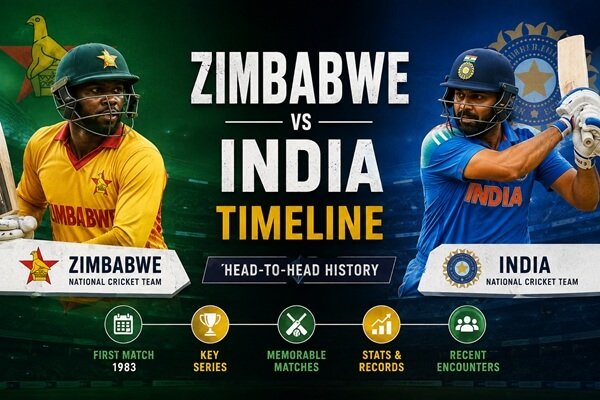
Every long-running cricket rivalry has a version like this one: a fixture where the outcome is rarely in doubt, yet the handful of times it has gone the other way are remembered far longer than any routine result. Zimbabwe vs India is exactly that kind of file, worth opening precisely because of how rarely the underdog wins, and precisely because of what those rare wins reveal about a Zimbabwean cricket program that has spent decades fighting an uphill battle against circumstances well beyond the boundary rope.
Case Summary
| Format | Played | India Won | Zimbabwe Won | Other |
| Test | 11 | 7 | 2 | 2 draws |
| ODI | 66 | 54 | 10 | 2 tied |
| T20I | 13 | 10 | 3 | — |
Figures reflect the most complete records available; a small number of sources list a slightly lower Test total of 9, likely due to differing treatment of drawn or abandoned fixtures from the 1990s. India’s advantage across every format is not close: Zimbabwe has managed roughly one win in every six meetings, all-time, across nearly 90 total matches.
Exhibit A: How the File Opened
Zimbabwe and India first met in 1983, during the Prudential World Cup in England, a group match India won by 5 wickets at Leicester. At the time, Zimbabwe were not yet a full Test nation, and would not be granted Test status until 1992. The two sides’ Test rivalry began that October, opening a chapter that would ultimately produce only eleven matches across thirteen years.
The early relationship was shaped heavily by mismatch. India, already an established Test nation with a deep pool of batting talent, faced a Zimbabwean side still building the infrastructure and player pipeline that would come to define its cricketing identity. The results reflected that gap almost immediately, and it would take the better part of two decades before Zimbabwe fielded a side genuinely capable of testing India across a full series rather than in isolated passages of play.
| EXHIBIT A · TEST CRICKET · HARARE, 2001The One That Got AwayIn the second Test of India’s 2001 tour, Zimbabwe chased down a target to win by 4 wickets, leveling the series 1-1 after India had won the first Test in Bulawayo by 8 wickets. It remains one of only two Test wins Zimbabwe has recorded against India in the fixture’s history, and the only one to come on home soil during a series India ultimately failed to win outright. |
Exhibit B: The Punishing Response
If 2001 briefly suggested a competitive rivalry was forming, the following year removed any doubt about the underlying gap in strength. When Zimbabwe toured India in 2001-02, India won both Tests comprehensively, including an innings and 101-run victory in Nagpur. A follow-up series in 2005 produced a similarly one-sided result, with India winning the opening Test in Bulawayo by an innings and 90 runs.
That 2005 series marked the last time the two nations played Test cricket against each other. Zimbabwe’s cricket board entered a period of serious institutional turmoil shortly afterward, and the team’s Test status was effectively suspended amid concerns raised by the ICC, keeping Zimbabwe out of the format for years. Test matches between the two sides have not resumed since, meaning this entire chapter of the rivalry has been frozen for two decades.
Exhibit C: The White-Ball Long Game
While Test cricket between the two sides stalled, one-day cricket kept the fixture alive almost continuously. Sixty-six ODIs have been played between Zimbabwe and India since that 1983 World Cup meeting, the widest sample of any format in this rivalry and the clearest picture of how consistently lopsided it has been: India has won 54 of those matches, more than four out of every five played.
T20 cricket, a much newer addition to the rivalry, has followed a similar pattern on a smaller scale. The two sides first met in the format in 2010, when India won by 6 wickets in Harare, and have played 13 T20Is since, with India winning 10. Nearly every T20I between the two nations has been played at the Harare Sports Club, making Zimbabwe’s home conditions the format’s almost exclusive venue for this fixture.
| EXHIBIT C · T20I · HARARE SPORTS CLUB, JULY 2024The Most Recent Entry in the FileIndia’s most recent meeting with Zimbabwe on record closed the fixture’s T20I chapter on a familiar note, a 10-wicket win to close out a five-match series. It was the latest reminder that even as India regularly sends young, developing squads on Zimbabwe tours, the gap in overall squad depth still tends to decide these matches. |
Why India Keeps Sending Understrength Squads, and Why It Rarely Matters
A distinctive feature of this rivalry, especially in white-ball cricket, is how often India has used these fixtures to test fringe and emerging players rather than fielding a first-choice XI. Tours to Zimbabwe have functioned almost like an extension of India’s domestic pipeline, giving uncapped or lightly capped players a first taste of international cricket in relatively lower-pressure conditions.
That approach explains part of why Zimbabwe’s occasional wins carry outsized attention. A win over a full-strength Indian side would be a significant upset on paper alone; a win over a young, developing Indian squad still counts in the record books the same way, and Zimbabwe’s players and fans have every right to celebrate it as a genuine result, even when outside observers reasonably note the context of who India actually fielded that day.
What the Numbers Don’t Capture
A head-to-head record this lopsided risks flattening a more interesting underlying story. Zimbabwe’s cricketing history includes a genuine golden generation in the late 1990s and early 2000s, built around players like Andy Flower, considered one of the finest wicketkeeper-batters of his era, and Heath Streak, a genuine allrounder threat with the ball. That generation is exactly the one responsible for Zimbabwe’s rare Test win over India in 2001, which is part of why that single result still gets referenced decades later: it came from a Zimbabwean side genuinely capable of competing, not just an isolated fluke.
The subsequent decline in Zimbabwe’s results against India tracks closely with a broader, well-documented period of instability in Zimbabwean cricket administration during the mid-2000s, rather than a sudden shift in playing quality alone. Understanding that context matters for reading the head-to-head record accurately: the gap reflects institutional history as much as it reflects any single era of on-field mismatch.
Exhibit D: The Rare ODI Upsets
Ten Zimbabwean wins across sixty-six ODIs is a thin sample, but it spans several distinct eras rather than clustering in one golden run. Some came during Zimbabwe’s strongest period around the turn of the millennium, when the side was competitive against most opponents, not just India. Others have come more recently, often against Indian squads missing several first-choice players due to rest, rotation, or scheduling conflicts with other India commitments elsewhere in the cricket calendar.
That mix matters for how the record should be read. A rivalry with ten wins spread across four decades tells a different story than ten wins clustered in a single dominant stretch. In Zimbabwe’s case, it suggests a team that has never been able to sustain competitiveness for long, but has also never been so far behind that an upset became statistically impossible, even in unfavorable eras for Zimbabwean cricket as a whole.
The Administrative Shadow Over This Rivalry
It is difficult to fully understand the gap in this fixture without acknowledging how much off-field turmoil shaped Zimbabwean cricket during the very years this rivalry might otherwise have grown more competitive. Political and economic instability within Zimbabwe during the 2000s had direct consequences for the national team, including player strikes, the departure of several senior players from international cricket, and years of reduced fixtures against top-tier opposition. India, by contrast, was entering one of the most resourced and commercially powerful periods in its cricketing history over that same stretch, widening an already real gap in infrastructure and player development pipelines.
Viewed that way, the head-to-head record is not simply a story of one team being permanently superior to the other. It is a story of two boards whose institutional trajectories diverged sharply at almost the exact moment this fixture might have become genuinely competitive, and a rivalry that has never quite had the chance to reset on equal footing since.
There is also a scheduling reality worth noting. Because Zimbabwe is not part of cricket’s most heavily broadcast bilateral cycle, fixtures against India tend to happen in short, tightly packed bursts, three or five matches at a time, rather than the kind of extended multi-format tours India plays against Australia or England. That compressed format leaves Zimbabwe little room to build momentum across a series even in years when individual performances suggest the gap might be narrowing, which is arguably as significant a factor in the lopsided record as any difference in raw talent between the two squads.
Who leads the overall head-to-head record between Zimbabwe and India? India, by a wide margin across every format, having won roughly 80 percent of all matches played between the two sides since 1983.
Has Zimbabwe ever beaten India in a Test match? Yes, twice. The most notable came in Harare in 2001, when Zimbabwe won by 4 wickets to level that year’s series 1-1.
Why haven’t Zimbabwe and India played a Test match since 2005? Zimbabwe’s Test program was effectively suspended for several years following serious administrative turmoil within Zimbabwe Cricket in the mid-2000s, and a Test rematch with India has not been scheduled since.
Does India usually send its strongest squad to play Zimbabwe? Not always. India has frequently used white-ball tours to Zimbabwe to give fringe and uncapped players early international experience, rather than fielding a first-choice XI.
What is Zimbabwe’s best generation of players in this rivalry? The late-1990s and early-2000s side built around Andy Flower and Heath Streak is widely regarded as Zimbabwe’s strongest, and produced the country’s most competitive results against India.
Where are most recent Zimbabwe vs India T20Is played? Almost exclusively at the Harare Sports Club, which has hosted nearly every T20I meeting between the two sides since the format began in this fixture in 2010.
Is Zimbabwe vs India likely to return to Test cricket soon? There is no confirmed timeline. A Test rematch would depend on both boards agreeing to schedule one, which has not happened in nearly two decades.
What is the biggest win either side has recorded in this fixture? India’s innings and 101-run win in Nagpur during the 2001-02 series stands as one of the most dominant results either side has produced against the other, part of a series in which Zimbabwe failed to pass 330 in either innings across both Tests.
Do Zimbabwe and India compete in the same ICC World Cup qualifying pathway? Yes, both nations have featured in ICC ODI World Cup Super League and qualifying structures in recent years, which is part of why their bilateral ODI fixtures have continued even without a resumed Test rivalry.
| Zimbabwe vs India is not a rivalry defined by competitive balance, and pretending otherwise would misread the record. But the file is more textured than the scoreline suggests: a genuine Test upset in 2001, a golden Zimbabwean generation that earned its results rather than stumbling into them, and a modern era where India’s understrength squads still usually find a way to win. The gap is real. So is the occasional reminder that Zimbabwean cricket, even now, is capable of making it a contest, and that on the right day, with the right eleven, the file can still surprise you. |